The challenge facing modern IT teams
IT service desks are under relentless pressure. Ivanti’s 2025 Digital Employee Experience (DEX) Report found that office workers endure an average of 6.3 tech interruptions per month; 3.6 from device and application problems and 2.7 from mandatory security updates. This translates to nearly $4 million in lost productivity annually for a company of just 2,000 employees1. And only a fraction of those issues are ever reported to the service desk. The issues that do get reported are frequently passed up the escalation chain, consuming specialist time, inflating ticket volumes and degrading the employee experience.
Traditional Level 1 (L1) support tools compound the problem. When a device issue arises and is reported, the analyst typically requires remote control of the device and must then navigate a fragmented set of utilities: Command Prompt, Task Manager, Event Viewer, MSINFO32, Services and PowerShell, to diagnose root cause. These tools are disruptive, slow, and inefficient. They interrupt the end user’s workflow, extend mean time to resolution (MTTR) and leave both analysts and employees frustrated.
The reality is that L1 analysts are being asked to solve increasingly complex problems with tools that were never designed for the scale, speed or complexity of today’s distributed, everywhere-work environments.
The answer: autonomous endpoint management
Ivanti Autonomous Endpoint Management (AEM) redefines how organizations manage and secure endpoints by making device management autonomous, predictive and protective2. Built on a foundation of real-time data, automation and AI, this approach transforms traditional endpoint operations into a proactive, intelligent system that continuously optimizes IT and security outcomes while elevating the employee experience3. IT and security outcomes while elevating the employee experience3.
At the heart of autonomous endpoint management is a unified platform that brings together digital employee experience (DEX), unified endpoint management (UEM) and security into a single, AI-powered motion. Eliminating tool sprawl, closing visibility gaps and enabling IT teams to shift from reactive firefighting to strategic, high-value work3.
The workspace and service desk intelligence capabilities within autonomous endpoint management are where this vision becomes tangible for IT support teams every day. They provide a comprehensive, 360-degree view of devices, users, applications and services in real time; empowering first-line analysts to resolve issues that would previously required specialist escalation. By simplifying user and device views and accelerating the path from issue detection to resolution, these capabilities reduce complexity, wait times and the costs associated with escalations, creating measurably better outcomes for end users and IT alike.
How it works: a smarter workflow for issue resolution
Ivanti Autonomous Endpoint Management workspace capabilities streamline issue resolution through a cohesive, intelligence-led workflow designed to keep the end user productive and the IT analyst firmly in control, without the noise, disruption or tool-switching that characterizes legacy support approaches.
1. Issue arises
The problem is identified. It’s either reported by the end user or, increasingly, detected proactively before the user even notices. Ivanti continuously monitors device health and productivity degradations, alerting support analysts ahead of user-reported friction. This proactive posture is a direct expression of autonomous endpoint management’s “predictive” principle: anticipating issues rather than simply reacting to them4.
2. Evaluate the digital experience (DEX) score
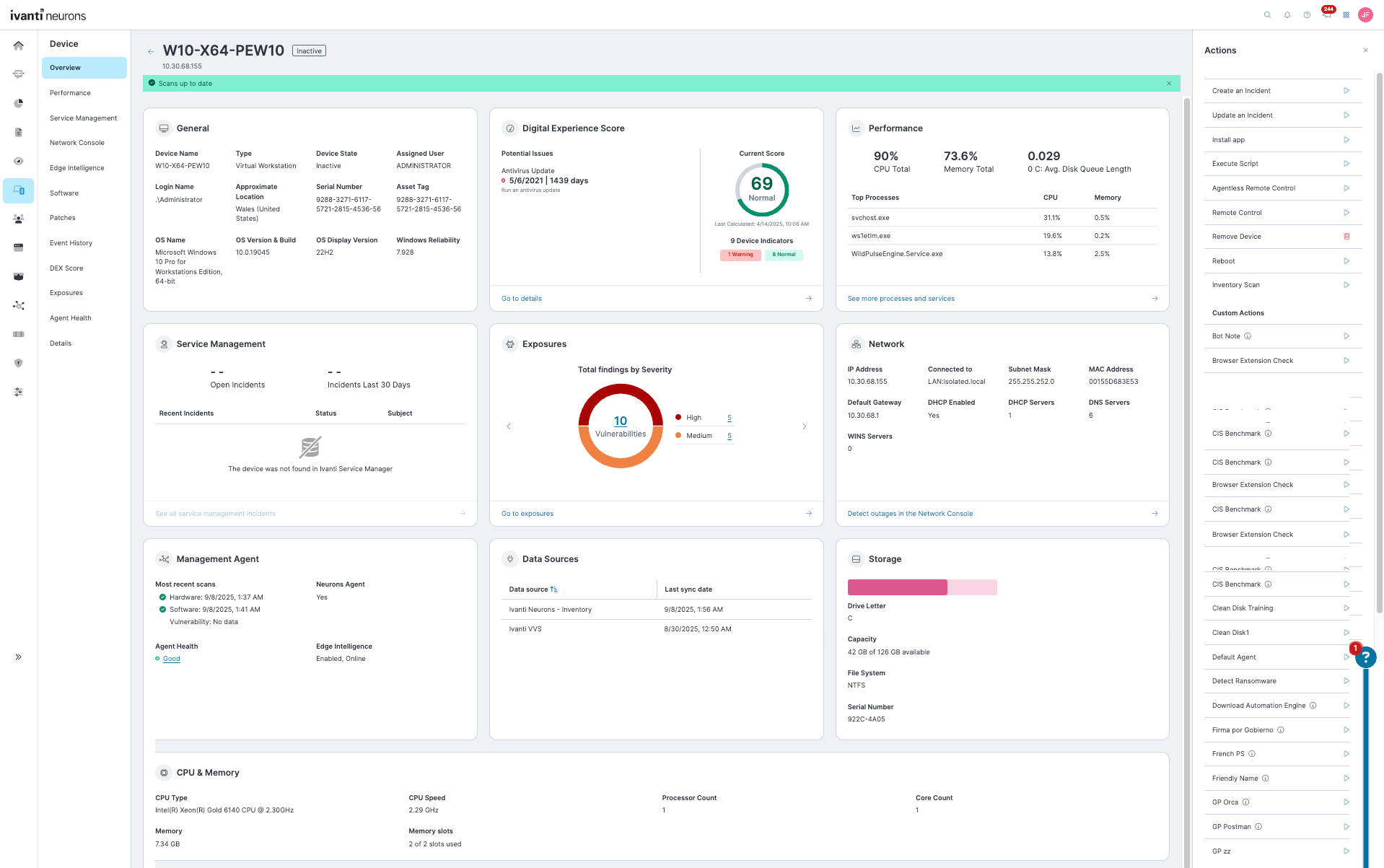
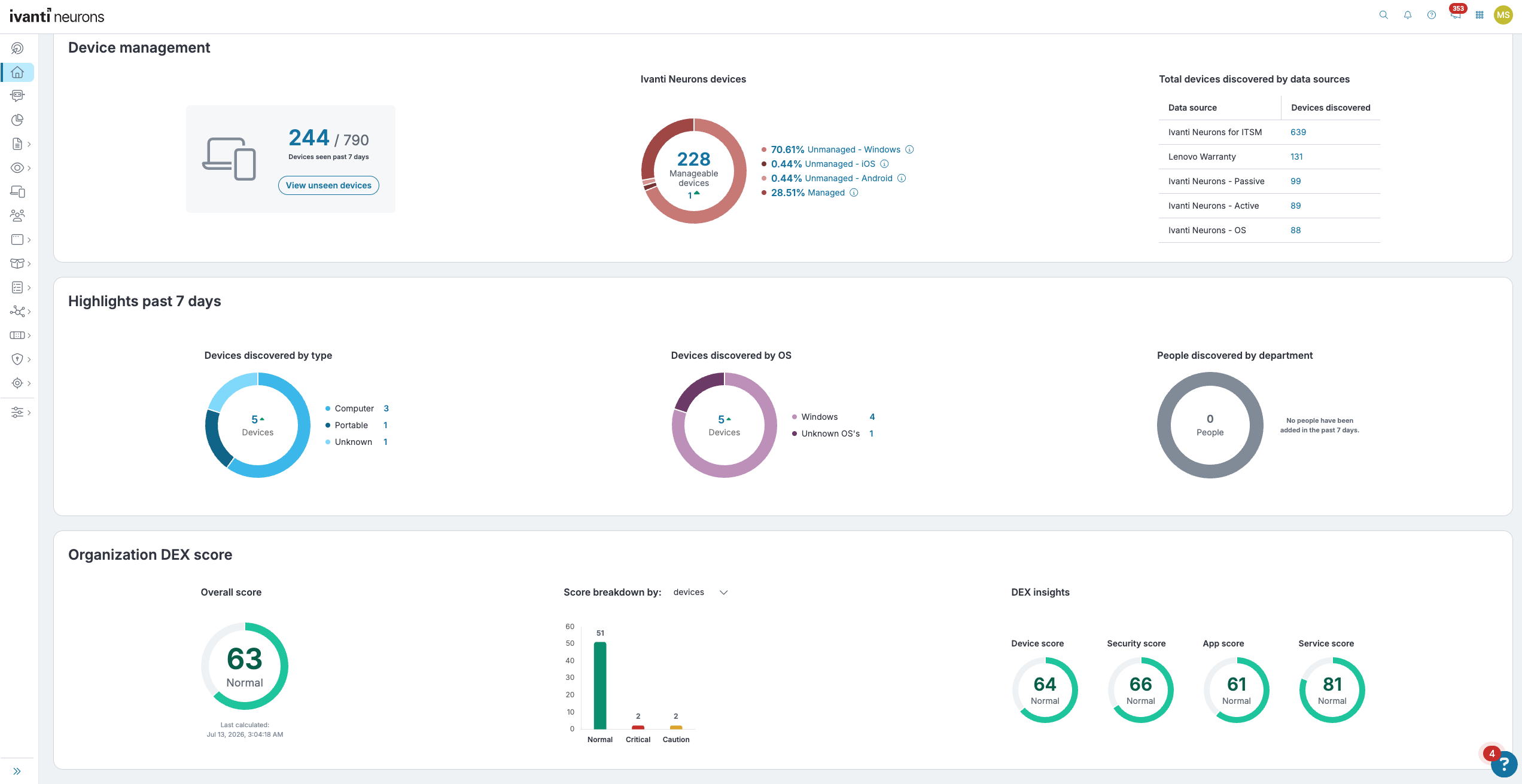
When an analyst receives an alert or ticket, the first step is assessing severity through the end user’s DEX score. The DEX score uses advanced algorithms, statistical models and AI/ML-based sentiment analysis to provide an objective, composite measure of the user’s digital experience. It analyzes historical device data to identify deviations from established baselines, standardizes metrics against the average and standard deviation of past performance and incorporates sentiment signals from open tickets to surface emerging issues early.
Key DEX score capabilities include:
- AI/ML-based anomaly detection across device, application, security, service and survey domains
- Sentiment analysis using a pre-trained model to assess employee mood from open ticket data
- Historical baseline comparison to detect meaningful deviations, not just point-in-time snapshots
This data-driven severity signal gives L1 analysts the context they need to prioritize effectively, and the confidence to act without unnecessary escalation.
3. Real-time device intelligence from the edge
In addition to the DEX score, resolving most issues requires deeper operational context. Ivanti’s Edge Intelligence capability delivers fleet-wide metrics from hundreds of data points in seconds using a sensor-powered, MQTT-based architecture, all without disrupting the end user5.
This architecture gives IT teams real-time visibility into device configurations, health status and security posture across every endpoint at the edge of the network. Analysts can query all edge devices using natural language processing (NLP), receiving instant operational awareness and real-time inventory insights without writing scripts or navigating multiple consoles5.
Edge Intelligence capabilities include:
- Real-time operational intelligence across the entire device fleet
- MQTT and sensor-powered architecture for low-latency, non-disruptive data collection
- Fleet-wide metrics from hundreds of data points returned in seconds
- Historical data collection to support trend analysis and proactive planning
- Natural language querying across all edge devices for instant answers
The result is that IT teams maintain comprehensive operational awareness of inventory, health and security configurations across the distributed edge, a foundational requirement for true autonomous endpoint management5.
4. Zero-impact troubleshooting
With DEX score data and real-time device intelligence in hand, analysts are equipped to diagnose root cause before taking any action on the device. Capabilities deliver a zero-impact troubleshooting experience covering network, processes, services, events and application reputation, ensuring no disruption to the end user during the diagnostic process.
Unlike traditional tools that require an analyst to visibly take over a user’s device, Ivanti enables analysts to troubleshoot invisibly and out-of-band. Analysts can diagnose and remediate device health, user account and cybersecurity hygiene issues from a single, unified console. When a resolution is identified, they can act immediately: resolving the issue live on the call, initiating an automation bot or having an ITSM ticket automatically created and pre-populated with device details, real-time intelligence and DEX score data.
Remote control
When direct intervention is required, Ivanti delivers fully featured remote control capabilities designed to minimize disruption while maximizing analyst effectiveness. Remote control supports both agentless and agent-based modes, ensuring coverage across every device type and connectivity scenario.
Remote control capabilities include:
- Agentless and agent-based remote control to meet every IT scenario
- Remote access supporting Everywhere Work across distributed, hybrid and remote environments
- File transfer and file share for direct, secure file delivery to or from the end user’s device
- Native chat within the UI for real-time communication during a remote session
- Multi-analyst collaboration enabling escalation within a session without handing off entirely
Automation bots for hands-free remediation
When remote control is not needed, automation bots provide a powerful, scalable path to remediation. Analysts can deploy custom action bots against single or multiple assets simultaneously, executing targeted remediation without any user interaction. The platform offers rich low-code/no-code orchestration, API-triggered bots and hundreds of out-of-the-box (OOTB) bots and stages, giving analysts a broad remediation toolkit without requiring scripting expertise.
Bot capabilities include:
- Remediation and troubleshooting against single or multiple assets simultaneously
- Rich low-code/no-code orchestration accessible to analysts of any technical level
- API-triggered bots for integration with existing IT workflows and external systems
- Hundreds of OOTB bots and stages covering common remediation scenarios out of the box
- Survey module for gathering user feedback post-resolution and monitoring experience trends
5. Issue resolved
The outcome of this intelligence-led workflow is a faster, less disruptive resolution and a measurable positive impact on both the end user and the IT team. End users return to productive work quickly, with minimal interruption. IT teams reduce escalation volume, shrink MTTR, and reclaim time to focus on strategic initiatives rather than repetitive L1 tasks.
AI Diagnostics: bridging the L1 skills gap
One of the most significant challenges facing IT service desks today is the growing skills gap at the L1 tier. As the complexity of endpoints and the diversity of device issues increase, L1 analysts are frequently expected to diagnose problems that have traditionally required specialist expertise.
AI Diagnostics is an advanced capability within Ivanti’s Autonomous Endpoint Management workspace toolset that directly addresses this challenge. Powered by large language models (LLMs) and real-time edge sensors, AI Diagnostics automates device issue detection and root cause analysis, transforming how analysts approach complex problems6.
The experience is intuitive by design. Analysts describe the symptom in plain language, for example, “device running hot” or “application won’t launch,” and the system translates that natural language input into a structured diagnostic query, drawing on live sensor data and AI reasoning to identify the most probable root causes. The analyst receives a clear, detailed summary of findings along with a severity-based priority score out of 10, enabling immediate, informed prioritization6.
High-priority issues are surfaced with a top-level summary designed for rapid action, so analysts can move from symptom to resolution quickly, without needing deep technical expertise in the specific failure domain7.
AI Diagnostics capabilities include:
- LLM-powered natural language input, describe symptoms in plain English, no scripting required8
- Automated root cause analysis using edge sensor data and advanced language models6
- Severity-based priority scoring (out of 10) with high-priority issue summaries for fast action
- Predictive analytics identifying recurring failure patterns across the device fleet8
- Natural language fleet querying powered by NLP for instant operational awareness6
- Continuous improvement as the models learn from real operational telemetry and organizational data9
By empowering L1 analysts to solve problems that would previously have required escalation, AI Diagnostics directly reduces resolution times, lowers escalation rates and gives back valuable time to both analysts and the specialists they would have engaged6.
Non-persistent VDI support: comprehensive coverage for modern virtual environments
As organizations increasingly adopt cloud-based and virtual desktop infrastructure (VDI) environments, the management complexity of those environments has grown significantly. Non-persistent VDI presents a particular challenge: virtual desktops are rapidly provisioned and deprovisioned, resetting to a clean state after each session. This complexity is further exacerbated by the shift towards Desktop as a Service (DaaS), a cloud-based solution that is gaining traction as VDI users seek more scalable and flexible options. Traditional endpoint management tools, which were built around the assumption of persistent devices with stable identities, struggle to keep up in both non-persistent VDI and DaaS environments, where the dynamic nature of the desktops challenges conventional management practices.
Ivanti Autonomous Endpoint Management now delivers dedicated non-persistent VDI support, enabling unified, automated management of non-persistent virtual desktops alongside physical endpoints; all within the same platform, under the same policies and with the same operational consistency10.
This capability eliminates the need for separate tooling or manual workarounds to handle the rapid provisioning cycles of non-persistent VDI. IT teams benefit from simplified operations and a seamless path to modern autonomous endpoint management capabilities, such as edge intelligence, automated policy assignment and bot-driven remediation, across both physical and virtual endpoints10.
Key benefits of non-persistent VDI support include:
- Unified management of non-persistent virtual desktops and physical devices from a single platform
- Full edge intelligence coverage, Sensors and real-time data collection function correctly across non-persistent desktop lifecycles, extending DEX and AEM capabilities to ensure robust tooling, including edge intelligence and remote control, for non-persistent devices
- Simplified operations, no separate tooling, no manual registration workflows for individual VDI sessions
- Seamless migration to modern autonomous endpoint management capabilities for organizations moving workloads to dynamic cloud environments10
- Comprehensive endpoint control across today’s hybrid environments, whether physical, virtual or cloud-hosted
For organizations running Citrix, VMware Horizon, Microsoft AVD or comparable VDI platforms, this capability ensures that the intelligence, automation and security posture delivered by Ivanti’s solution extend uniformly to every virtual desktop, regardless of how frequently those desktops are provisioned and reset.
Ivanti value: from overburdened to optimized
IT teams deserve tools that work for them, not against them. We built workspace and service desk intelligence capabilities with a singular conviction: Every analyst at every skill level should have access to the insight and automation they need to resolve issues quickly, confidently and without unnecessary escalation.
Ivanti Autonomous Endpoint Management delivers:
- Actionable real-time intelligence across every endpoint, user and application in the environment
- AI-powered diagnostics that bridge the L1 skills gap and accelerate root cause identification
- Zero-impact troubleshooting that protects end-user productivity during every investigation
- Flexible remediation through remote control, automation bots and ITSM integration
- Unified VDI and physical endpoint management including full non-persistent VDI coverage
- A proactive, predictive posture that surfaces issues before users report them
The result is a measurable improvement across the metrics that matter most: reduced escalations, lower ticket volume, faster resolution, stronger security posture and a better digital experience for every employee11.
Automation tools empower analysts to cut through the complexity and cost associated with escalations, giving time back to IT to focus on what matters, and giving end users the seamless, productive digital experience they expect.
About Ivanti
Ivanti is a global enterprise IT and security software company dedicated to unlocking human potential by managing, automating and protecting data and systems to empower continuous innovation. With adaptable software solutions tailored to customer needs, Ivanti empowers IT and security teams to enhance operational efficiency, cut costs and proactively mitigate security risks. At the heart of Ivanti’s offerings is the AI-powered Ivanti Neurons platform, which transforms the way IT and security teams operate. By delivering unified, reusable services and tools, the platform helps ensure consistent visibility, scalability, and secure solution implementation, enabling teams to work smarter, not harder. Ivanti follows “Secure by Design” principles to provide software solutions that scale with our customers’ needs to help enable IT and Security to improve operational efficiency while reducing costs and proactively reducing risk. Ivanti fosters an inclusive environment where diverse perspectives are honored and valued, reflecting a commitment to a sustainable future for customers, partners, employees and the planet. Learn more at www.ivanti.com and follow us on social media @GoIvanti.
Sources
1. Tech Disruptions Cost Companies Millions of Dollars in Lost Productivity A… (https://www.ivanti.com/company/press-releases/2025/tech-disruptions-cost-companies-millions-of-dollars-in-lost-productivity-annually-according-to-research-from-ivanti)
2. https://www.ivanti.com/releases/2026/q1
3. Ivanti Unveils AI-Driven Innovations to the Neurons Platform to Power the… (https://www.ivanti.com/company/press-releases/2026/ivanti-unveils-ai-driven-innovations-to-the-neurons-platform-to-power-the-future-of-it-and-security)
4. https://www.ivanti.com/autonomous-endpoint-management
5. Unified Endpoint Management Solutions | Ivanti (https://www.ivanti.com/products/ivanti-neurons-for-unified-endpoint-management)
6. Q4 2025 Quarterly Product Release | Ivanti (https://www.ivanti.com/releases/2025/q4)
7. Ivanti Product Enhancements Drive Stronger Security and Streamlined User Experience for Modern Enterprises (https://www.ivanti.com/company/announcements/2025/ivanti-product-enhancements-drive-stronger-security-and-streamlined-user-experience-for-modern-enterprises)
8. Ivanti Neurons for Digital Experience (https://www.ivanti.com/resources/solution-briefs/ivanti-neurons-for-digital-experience)
9. https://www.ivanti.com/ivanti-neurons
10. Q4 2025 Quarterly Product Release | Ivanti (https://www.ivanti.com/releases/2025/q4)
11. The Autonomous Endpoint Management Advantage (https://www.ivanti.com/resources/research-reports/aem)