Why conversational self-service matters
For IT leaders responsible for service and asset management, speed, quality and cost efficiency are business imperatives. Escalating service demands, mounting IT complexity and pressure to do more with less require a shift from reactive, form-heavy support experiences to more intelligent service delivery.
Traditional ITSM tools often depend on manual processes, form-heavy portals and rule-based workflows. The result can be overwhelmed analysts, frustrated employees and higher operational costs.
AI-powered self-service, governed within ITSM
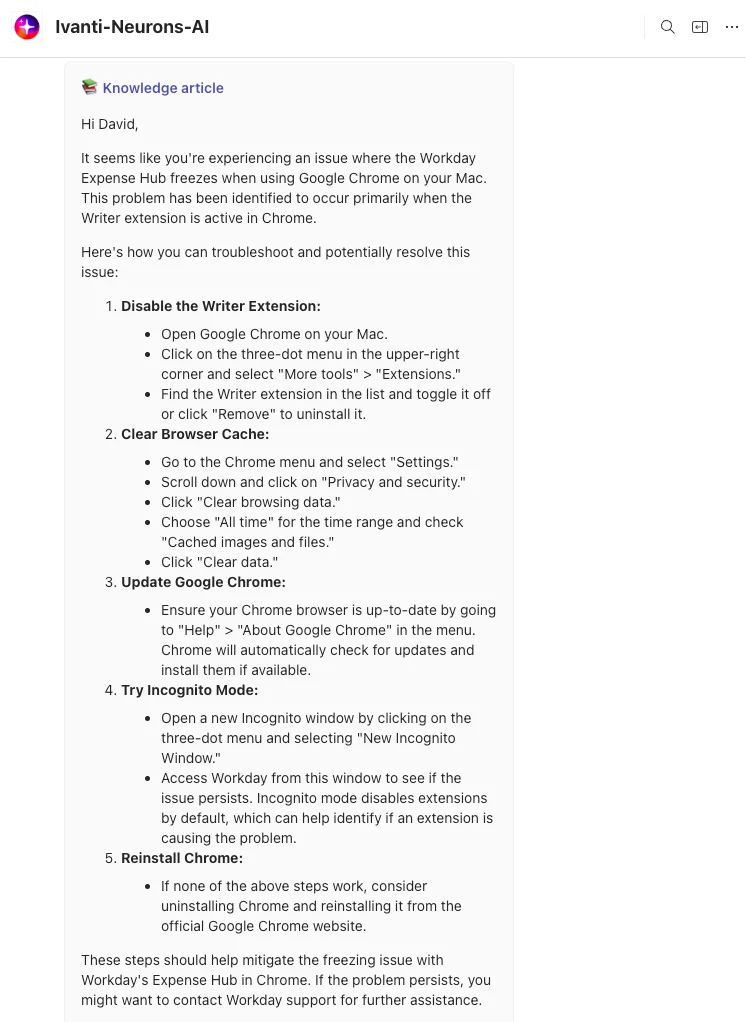
Eligible users can chat with the AI Agent through Microsoft Teams or web chat in Ivanti ITSM. Administrators retain control over incident templates, service desk teams receive better context, and leaders gain visibility into how users are engaging.
The AI Agent combines conversational assistance, curated knowledge access and governed actions to simplify self-service without claiming unrestricted autonomy.
A better self-service experience
- Meet users where they work. Offer conversational access through Microsoft Teams or web chat in Ivanti ITSM, with a smooth handoff to a live agent when needed.
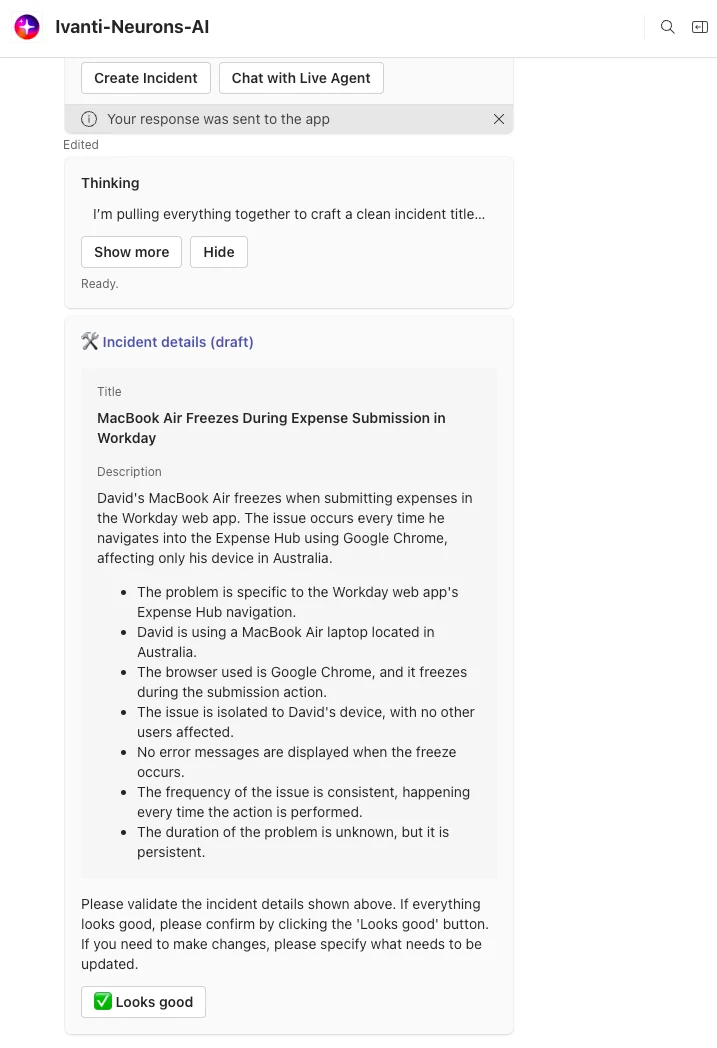
- Create more consistent incidents. Use administrator-designated Self-Service templates, retain the configured description, add a timestamped conversation summary and identify Agentic AI as the source.
- Keep users oriented. After a recommended service request form opens, users can confirm they are all set, start a new query or connect with a live agent.
- Understand engagement. Track service request deep links opened, engagement rate, conversations with no deep link opened and selected AI-assisted outcomes.
- Support multilingual environments. Let users interact with Agentic AI in their preferred language and receive responses in the same language, making self-service more accessible for global teams.
Core capabilities
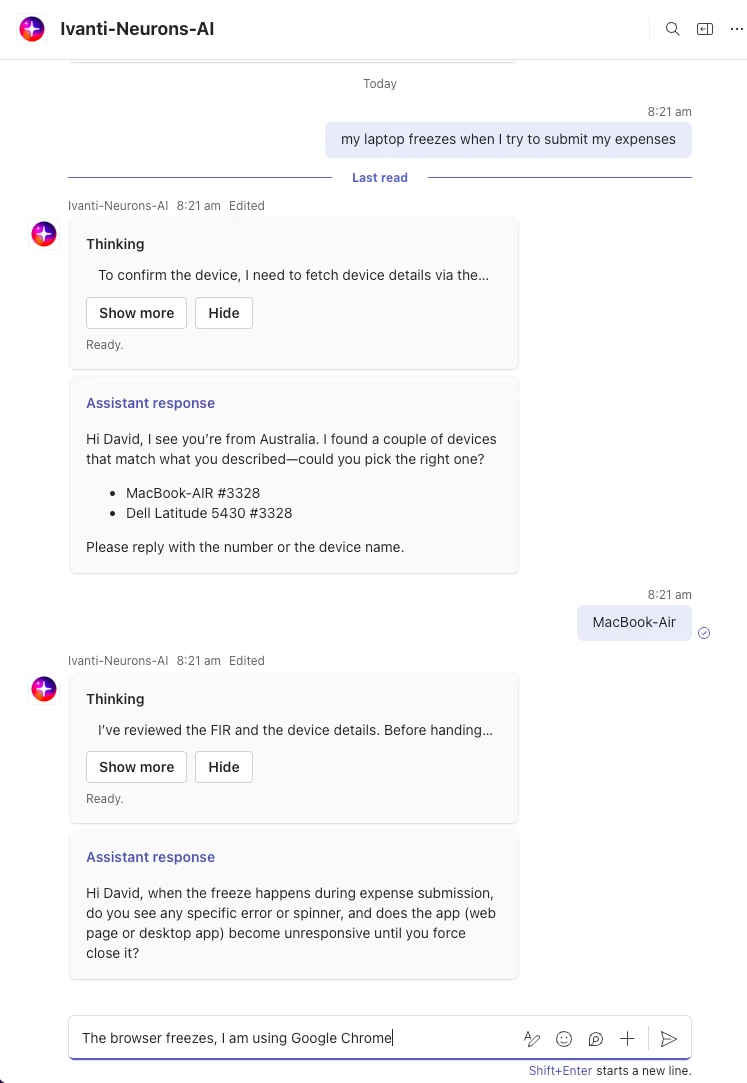
Conversational chat
Provide a natural-language self-service experience embedded right in Ivanti ITSM for eligible users, with access through Microsoft Teams or web chat.
Knowledge search
Enable curated knowledge search across approved internal and external sources.
Governed incident creation
Limit the Incident Creation Agent to templates configured under Self-Service templates.
Richer incident context
Retain template descriptions, add a timestamped conversation summary, identify Agentic AI as the source and provide explicit choices for next steps.
SharePoint knowledge source
Connect SharePoint sites as external knowledge sources for the Knowledge Base Agent so existing approved content can power more relevant answers.
Value across Ivanti ITSM
Self-service users |
Service desk teams |
ITSM administrators and leaders |
|
Use conversational self-service in the web experience and move easily between self-service, a new query, and live support. |
Receive incidents that retain template context, include an AI-generated conversation summary and identify Agentic AI as the source. |
Configure approved internal and external knowledge base articles for common issue deflection. Customize greetings, prompts and advanced agent configurations. Configure Self-Service templates and monitor engagement. |
Business outcomes
Improve employee self-service
Help employees find answers, navigate service requests and create incidents through natural-language interactions rather than relying only on portal navigation and forms.
Improve incident quality and context
Use administrator-designated templates, retain configured descriptions and add timestamped conversation summaries so service desk teams receive more consistent information.
Reduce service desk effort
Help users find relevant knowledge and navigate service options, with a clear path to live support when needed.
Maintain control and governance
Keep administrators in control of approved knowledge sources, incident templates, prompts and agent configuration.
Precisely scoped automation
The AI Agent automates and assists with defined activities within Ivanti ITSM, including self-service interactions, incident records, recommended forms and handoffs. It does not claim autonomous endpoint, application or infrastructure remediation.