Executive summary
Agentic AI represents a transformative shift in IT Service Management (ITSM), moving beyond simple automation to autonomous, intelligent systems capable of independent decision-making and action. This whitepaper explores the strategic benefits of agentic AI, identifies optimal use cases across ITSM functions and provides a framework for determining when agentic AI is, and is not, the right solution for your organization.
Key findings
Measurable Business Impact: Organizations implementing agentic AI achieve 40-60% productivity gains, 50-70% reduction in resolution times, 25-40% lower cost-per-ticket and 60-80% self-service adoption rates delivering immediate, quantifiable ROI.
Strategic Differentiation: Agentic AI transforms IT from cost center to value driver through autonomous operations, proactive issue prevention (30-40% incident reduction) and strategic resource allocation enabling innovation initiatives.
Readiness is Critical: Success requires clean, integrated data, well-defined workflows and organizational readiness. Most organizations are underprepared despite enthusiasm — addressing foundational gaps is essential before deployment.
Functional Transformation: Agentic AI revolutionizes five core ITSM areas: self-service (conversational AI), service desk (intelligent automation), insights & analytics (predictive intelligence), infrastructure & operations (autonomous remediation) and asset management (automated lifecycle).
When to Defer: Organizations with insufficient data quality, undefined processes, limited integration capabilities, regulatory barriers, cultural resistance or low ticket volumes (under 100-200 monthly) should address foundational issues before pursuing agentic AI.
1. Understanding agentic AI in ITSM
What is agentic AI?
Agentic AI refers to advanced artificial intelligence systems capable of autonomous decision-making and action-taking to achieve specific goals. Unlike traditional rule-based automation or even generative AI that simply responds to prompts, agentic AI can understand complex problems, set objectives, plan multi-step actions, and execute tasks with minimal human oversight.
In the context of IT Service Management, agentic AI transforms the service desk from a reactive support function into a proactive, self-optimizing operational brain. These AI agents can:
- Perceive and analyze incidents in real-time, understanding context and dependencies
- Make autonomous decisions about prioritization, routing and resolution strategies
- Execute end-to-end workflows without human intervention
- Learn from past interactions to continuously improve performance
- Collaborate with human agents and other AI systems to solve complex problems
- Proactively identify and prevent issues before they impact users
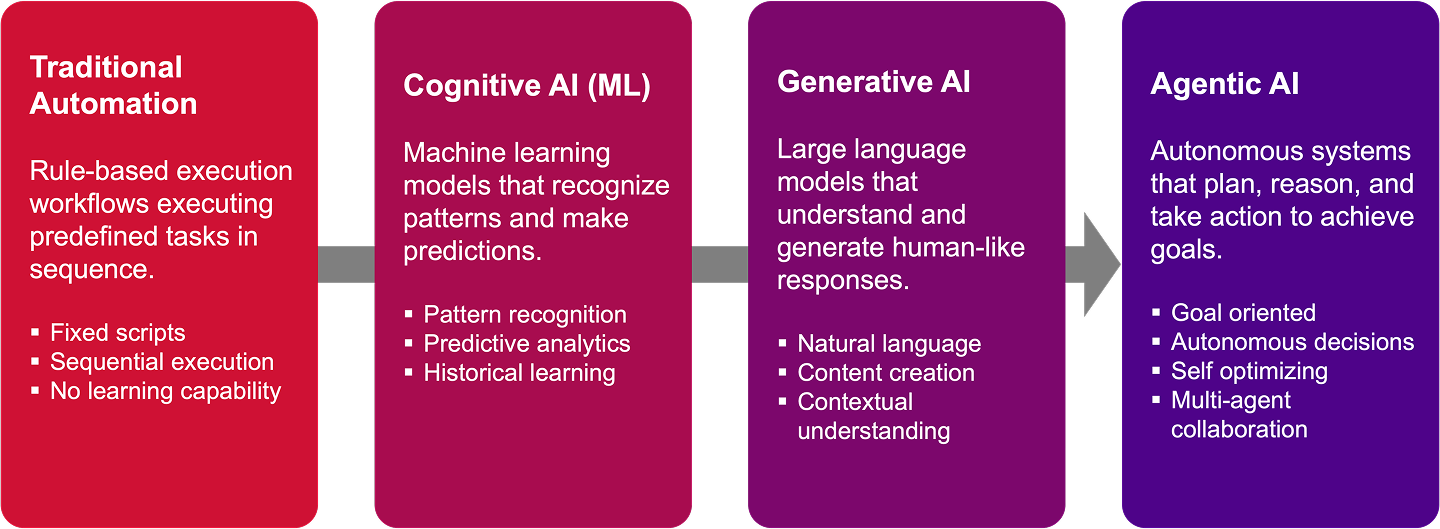
The evolution from automation to agentic AI
The journey to agentic AI represents a significant leap in capability maturity and is an evolution of your processes:
2. The strategic benefits of agentic AI
Operational excellence
Exponential productivity gains
Agentic AI eliminates the linear relationship between workload and headcount. By autonomously handling routine tasks, AI agents can process hundreds of tickets simultaneously, freeing human agents to focus on complex, high-value work. Organizations report expected productivity improvements up to 80% within the first year of implementation.
Dramatic reduction in resolution times
Autonomous AI agents can diagnose and resolve common incidents in seconds rather than hours. Mean time to resolution (MTTR) decreases by 50-70% for tier 1 and tier 2 issues, while automated root cause analysis accelerates complex problem resolution.
24/7 autonomous support
Unlike human teams constrained by business hours and time zones, agentic AI provides always-on support. Users receive immediate assistance regardless of when issues arise, dramatically improving employee satisfaction, and reducing downtime costs.
Proactive issue prevention
By continuously monitoring infrastructure and analyzing patterns across multiple data sources, agentic AI can identify anomalies and potential failures before they cause incidents. This shift from reactive to proactive support reduces incident volumes by 30-40%.
Consistent service quality
AI agents follow established procedures with consistency, eliminating variations in service quality that occur with human agents. Every user receives the same high-quality experience regardless of which agent handles their request.
Business impact
Cost optimization
Agentic AI reduces operational costs through multiple mechanisms: lower ticket volumes via self-service automation, reduced escalations to expensive tier 3 resources, decreased overtime costs, and elimination of repetitive manual work. Organizations typically see a 25-40% reduction in cost-per-ticket.
Enhanced employee experience
When employees receive instant, accurate support through natural conversational interfaces, satisfaction scores increase dramatically. Self-service adoption rates improve from 20-30% to 60-80%, and employee net promoter scores (eNPS) for IT services rise by 15-25 points.
Strategic resource allocation
By automating routine work, IT teams can redirect resources toward strategic initiatives like digital transformation, security enhancements, and innovation projects. This shift transforms IT from a cost center to a value driver.
Improved compliance and governance
Agentic AI maintains complete audit trails, ensures consistent application of policies, and enforces security protocols without exception. This reduces compliance risks and simplifies regulatory audits.
Data-driven decision making
AI systems continuously analyze service desk operations, identify trends, bottlenecks, and optimization opportunities. Leaders gain unprecedented visibility into IT performance and can make informed decisions backed by comprehensive data.
3. When to implement agentic AI
While agentic AI offers compelling benefits, successful implementation requires certain organizational conditions and readiness factors. Understanding when to adopt this technology ensures maximum value and minimizes implementation risks.
Ideal scenarios for agentic AI adoption
High-volume, repetitive request environments
Organizations experiencing large volumes of similar, routine requests are ideal candidates. When 40-60% of tickets involve password resets, software access requests or basic troubleshooting, agentic AI can dramatically reduce workload and improve response times.
Scaling challenges
When ticket volumes grow faster than IT headcount can scale, agentic AI provides a sustainable solution. Rather than continuously adding staff, organizations can deploy AI agents that handle exponentially more work without proportional cost increases.
Multi-channel, always-on support requirements
Organizations with global operations, distributed workforces or 24/7 business requirements benefit immensely from autonomous AI agents that provide consistent support across all channels and time zones without requiring shift coverage.
Mature data and process foundations
Organizations with clean, integrated data across systems, well-documented procedures, and standardized workflows can implement agentic AI most effectively. The AI learns from historical patterns and executes established processes autonomously.
ITIL-aligned service management
Companies following IT Infrastructure Library (ITIL) frameworks or similar best practices have the structured environment agentic AI needs to operate effectively. Clear incident, problem, and change management processes provide the foundation for autonomous operations.
4. The journey to agentic AI adoption
Agentic AI represents the pinnacle of IT automation maturity, but successful implementation requires progressing through foundational stages. Organizations at different maturity levels should focus on specific capabilities before adopting full autonomy. This journey ensures sustainable adoption with measurable value at each stage.
The agentic AI maturity model
Most organizations progress through four distinct maturity stages on their journey to agentic AI. Understanding your current stage helps identify the right next steps and avoid premature adoption that leads to disappointing results.
Stage 1: foundation building
Focus area: data quality and process standardization
Current State: Fragmented data across systems, inconsistent service desk procedures, poor documentation, legacy systems with limited integration or low ticket volumes (under 100-200 monthly).
Key Actions:
- Consolidate and clean Configuration Management Database and asset data
- Document and standardize service desk workflows
- Establish data governance policies and ownership
- Improve knowledge base quality and organization
- Implement basic workflow automation for simple tasks
- Build API integration capabilities for key systems
Solution: Traditional workflow automation, knowledge management systems, basic ticketing improvements, and process documentation initiatives.
Expected Outcomes: Improved data consistency, standardized procedures, increased adoption of self-service through knowledge bases, foundation for future AI adoption.
Stage 2: intelligent assistance
Focus area: AI-augmented human operations
Current State: Clean foundational data, documented processes, integrated systems, but still relying on human decision-making for most tasks. Ready to introduce AI but not prepared for full autonomy.
Key Actions:
- Deploy AI copilots to assist agents with ticket analysis
- Implement intelligent ticket routing and categorization
- Add AI-powered knowledge base search
- Introduce chatbots for common questions (with human escalation)
- Enable AI to draft responses for agent review
- Deploy predictive analytics for capacity planning
Solution: Generative AI assistants, AI-enhanced knowledge management, virtual agents with guardrails, predictive analytics dashboards.
Expected Outcomes: 20-30% productivity improvement, faster resolution through AI suggestions, improved first-call resolution, reduced cognitive load on agents.
Stage 3: selective autonomy
Focus area: autonomous operations for specific use cases
Current State: High trust in AI recommendations, mature data and processes, comfortable with AI decision-making for well-defined scenarios. Ready for AI to operate independently in controlled domains.
Key Actions:
- Enable autonomous resolution for password resets and access requests
- Deploy AI agents for specific workflows (provisioning, basic troubleshooting)
- Implement proactive monitoring with automated remediation
- Allow AI to close tickets autonomously for routine issues
- Expand chatbot autonomy with confidence-based escalation
- Deploy predictive maintenance for infrastructure
Solution: Task-specific AI agents, autonomous virtual assistants for defined scenarios, AIOps for infrastructure monitoring, intelligent automation platforms.
Expected Outcomes: 40-50% productivity gains, 30-40% ticket deflection, proactive issue prevention, measurable cost reduction (15-25% cost per ticket).
Stage 4: agentic AI adoption
Focus area: full autonomous operations with multi-agent orchestration
Current State: High AI maturity, comprehensive autonomous operations for specific tasks, organizational culture embracing AI, ready for enterprise-wide agentic deployment.
Key Actions:
- Deploy persona-based AI agents (Service Desk Agent, Operations Engineer, Self-Service Concierge)
- Enable multi-agent collaboration for complex scenarios
- Implement end-to-end autonomous workflows from detection to resolution
- Deploy continuous learning systems that improve autonomously
- Orchestrate AI agents across ITSM, ITAM and security functions
- Achieve true self-healing infrastructure
Solution: Enterprise agentic AI platforms (like Ivanti Neurons ITSM), multi-agent orchestration systems, and comprehensive AIOps platforms.
Expected Outcomes: Full metrics realization: 50-70% MTTR reduction, 60-80% self-service adoption, 25-40% cost-per-ticket reduction, 40-60% productivity gains, proactive prevention becoming standard.
Finding your position on the journey
Assess your current maturity stage by evaluating these key dimensions:
- Data Quality: Is your CMDB accurate, complete, and updated regularly?
- Process Maturity: Are procedures documented, standardized, and consistently followed?
- Integration Readiness: Can your systems exchange data via APIs?
- Cultural Acceptance: Does your organization trust AI-driven recommendations?
- Enablement and organization change: Ensure good communication across the organization, enabling and bringing each department and person on the AI journey.
- Technical Capability: Do you have the infrastructure to support AI workloads?
- Governance Framework: Are AI usage policies, accountability and risk management defined?
Organizations should focus on mastering their current stage before advancing. Skipping stages or rushing to agentic AI without foundational capabilities leads to failed implementations, wasted resources and organizational skepticism that hinder future adoption.
Special considerations
Regulatory Industries: Healthcare, finance and government sectors face strict compliance requirements around automated decision-making. These organizations may operate in Stage 2-3 longer than others, requiring human oversight even when technical capabilities support autonomy. Focus on AI-assisted operations with comprehensive audit trails with humans in the loop for critical decisions.
Small Organizations: Companies with low ticket volumes (under 100-200 monthly) may find Stage 1-2 solutions more cost effective than full agentic AI. Basic automation and improved self-service knowledge bases deliver strong ROI without the complexity and cost of enterprise agentic platforms.
Legacy Technology Environments: Organizations with significant technical debt should invest in Stage 1 foundational work before pursuing AI. Modern integration capabilities, API availability and data accessibility are prerequisites for successful AI adoption at any stage.
Governance framework
Operational guardrails for agentic AI ensure that autonomous systems behave safely, predictably and in alignment with organizational and societal expectations. These guardrails combine technical and procedural controls, such as automated fallbacks that revert the system to a safe state when uncertainty or policy violations are detected; a centrally governed “kill switch” that allows rapid shutdown of agentic behaviors during anomalous or harmful actions; and structured human‑in‑the‑loop checkpoints for high‑impact decisions to preserve accountability.
Robust auditability and traceability mechanisms record agent actions, decision rationales, and data flows, enabling post‑incident investigation, compliance verification, and continuous model improvement. Together, these guardrails create a controlled operational envelope—ensuring that agentic AI enhances productivity while remaining safe, interpretable, and aligned with organizational risk protocols.
5. Agentic AI use cases across ITSM functions
Agentic AI transforms every dimension of IT Service Management, from self-service to asset management. Understanding how autonomous AI agents can enhance each functional area helps organizations identify high-impact implementation opportunities and build comprehensive deployment roadmaps.
Self-service
Empowering users with autonomous assistance
The Self-Service Challenge: Traditional self-service portals create friction through complex forms, navigation difficulties, and rigid categorization. Users struggle to articulate problems using IT terminology, often abandon self-service attempts, and create tickets unnecessarily. Knowledge base articles remain undiscovered, and automated resolution actions are not actioned.
Agentic AI Transformation: AI-powered self-service agents function as conversational concierges, meeting users where they work — in Teams, Slack or web portals. Users describe issues in natural language without navigating forms or categories. The AI agent understands intent, asks clarifying questions, searches knowledge bases automatically and executes resolutions autonomously when possible.
Key Use Cases:
- Password resets and account unlocks – Autonomous verification and reset without human intervention
- Software access requests – Automated provisioning based on role and approvals
- How-to questions – Instant answers from knowledge base with contextual recommendations
- Service catalog requests – Conversational ordering without form complexity
- Status inquiries – Real-time updates on pending requests
- Hardware requests – Equipment ordering with automatic approval routing
- Device troubleshooting -–Automated diagnostics and remediation
- Email configuration – Step-by-step guided assistance with automated setup
Business Impact: Organizations achieve 60-80% self-service adoption rates (up from 20-30% with traditional portals), deflect 40-50% of tickets before they reach the service desk, resolve common issues in under 60 seconds and dramatically improve employee satisfaction scores. Self-service AI agents can handle thousands of simultaneous conversations, providing instant support regardless of time zone or business hours.
Service desk
Augmenting agents with intelligent automation
The Service Desk Challenge: Service desk agents face overwhelming ticket volumes, repetitive tasks consuming 60-70% of their time, inconsistent service quality across teams, knowledge gaps from staff turnover and difficulty prioritizing urgent issues. Agents waste time searching for information, struggle with complex triage decisions, and experience burnout from monotonous work.
Agentic AI Transformation: AI agents become digital teammates working alongside human agents. They automatically triage and categorize incoming tickets, route requests to appropriate teams instantly, generate comprehensive ticket summaries from long conversation threads, suggest solutions from historical resolutions, draft accurate responses and handle routine tasks autonomously while escalating complex issues to humans.
Key Use Cases:
- Intelligent ticket routing – Automatic assignment based on content, urgency, expertise required
- Auto-categorization and prioritization – Consistent classification using ML models
- Suggested resolutions – AI recommendations from similar past tickets
- Draft responses – Pre-written replies for agent review and customization
- Sentiment analysis – Identification of frustrated users requiring immediate attention
- Knowledge article recommendations – Relevant documentation surfaced automatically
- Similar incident detection – Identification of related tickets and known issues
- Automated tier 1 resolution – Complete handling of routine requests without human intervention
- Multi-language support – Real-time translation enabling global support
- Ticket summarization – Concise overviews of complex, multi-comment tickets
Business Impact: Service desk agents resolve 30-40% more tickets with AI assistance, first-call resolution rates improve by 25-35%, average handle time decreases by 40-50% for routine issues and agent satisfaction increases as they focus on interesting, complex problems rather than repetitive tasks. New hire productivity accelerates with AI-guided assistance, reducing training time by 50%.
Insights and analytics
Data-driven service optimization
The Analytics Challenge: IT leaders struggle to extract actionable insights from massive volumes of service desk data. Traditional reporting provides lagging indicators but fails to predict future issues or identify root causes. Data silos prevent comprehensive analysis, and manual report generation consumes valuable analyst time. Leaders lack visibility in hidden patterns, emerging trends, and optimization opportunities.
Agentic AI Transformation: AI-powered analytics continuously analyze service desk operations, automatically identifying trends, anomalies and opportunities for improvement. Natural language interfaces enable leaders to ask questions conversationally and receive instant, data-driven answers. Predictive models forecast future ticket volumes, resource requirements, and potential service disruptions. AI agents proactively surface insights requiring attention rather than waiting for manual discovery.
Key Use Cases:
- Predictive ticket volume forecasting – Anticipate staffing needs based on historical patterns and upcoming events
- Automated root cause analysis – Identify underlying problems causing multiple incidents
- Service quality monitoring – Real-time tracking of SLA compliance and service health
- Agent performance analytics – Objective measurement of productivity and quality
- Trend detection and alerts – Automatic notifications of unusual patterns or emerging issues
- Cost optimization recommendations – Identification of expensive processes and automation opportunities
- Knowledge gap analysis – Detection of areas lacking documentation or frequent questions
- User satisfaction prediction – Early warning of declining satisfaction before it impacts scores
- Capacity planning – Data-driven recommendations for resource allocation
- Conversational business intelligence – Natural language queries returning instant visualizations and answers
Business Impact: Leaders gain real-time visibility into service operations with automated executive dashboards updating continuously. Predictive insights enable proactive resource planning, preventing service degradation during peak periods. Root cause analysis reduces recurring incidents by 30-40% through systematic problem elimination. Cost optimization recommendations identify 15-25% savings opportunities through strategic automation investments.
Infrastructure and operations
Proactive monitoring and autonomous remediation
The IT Operations Challenge: IT operations teams manage increasingly complex, distributed infrastructure generating overwhelming alert volumes. Signal-to-noise ratio remains poor with false positives wasting time on non-issues. Incident response requires manual correlation across multiple monitoring tools, delayed escalation to subject matter experts, and reactive firefighting rather than proactive prevention. Mean time to detect (MTTD) and mean time to resolve (MTTR) remain unacceptably high.
Agentic AI Transformation: Agentic AI revolutionizes IT operations through intelligent alert correlation, automated incident detection, and autonomous remediation. AI agents continuously monitor infrastructure, correlate events across systems, suppress noise while highlighting genuine issues, automatically diagnose root causes, execute remediation workflows and engage appropriate resources when human intervention is required. The system learns from each incident, continuously improving detection and response.
Key Use Cases:
- Intelligent alert correlation – Grouping related alerts to identify true incidents vs. noise
- Automated incident detection – Proactive identification of degrading services before user impact
- Autonomous remediation – Self-healing actions for common infrastructure issues (restart services, clear caches, rebalance loads)
- Predictive maintenance – Forecasting system failures before they occur based on performance trends
- Root cause analysis – Automated diagnosis using logs, metrics, and dependency maps
- Smart escalation – Automatic engagement of appropriate SMEs based on incident characteristics
- Change impact analysis – Predicting risks of proposed changes using historical data
- Capacity management – Automatic resource scaling based on demand patterns
- Security incident response – Automated detection and containment of anomalous behavior
- Post-incident review generation – Comprehensive RCA documentation created automatically
Business Impact: Operations teams reduce MTTR by 60-70% through automated diagnosis and remediation, decrease alert noise by 80-90% through intelligent correlation, prevent 30-40% of incidents through predictive detection and shift from reactive firefighting to proactive optimization. On-call burden decreases significantly as AI handles routine incidents autonomously, improving engineer work-life balance and retention.
Asset management
Intelligent asset discovery and lifecycle automation
The Asset Management Challenge: Organizations struggle to maintain accurate, up-to-date asset inventories as devices proliferate across cloud, on-premises and edge environments. Manual asset discovery misses shadow IT and unauthorized devices. Software license compliance remains complex with over-licensing wasting budget and under-licensing creating audit risk. Asset lifecycle management requires manual processes for procurement, provisioning, maintenance, and retirement. Integration between asset management and service desk systems remains fragmented.
Agentic AI Transformation: AI-powered asset management continuously discovers and catalogs all assets across the enterprise, automatically updating the CMDB with relationships and dependencies. Intelligent agents monitor software usage to optimize licensing, predict hardware failures before they occur, automate provisioning workflows, and provide comprehensive asset context to service desk operations. AI correlates asset data with incidents to identify problematic devices, vendors, or configurations.
Key Use Cases:
- Autonomous asset discovery – Continuous scanning and cataloging of all enterprise assets
- CMDB auto-population and updates – Automatic maintenance of configuration items and relationships
- Software license optimization – Usage monitoring and recommendations for license reallocation
- Hardware lifecycle management – Automated tracking of age, warranty, and performance
- Predictive hardware failure – Early warning of device issues based on performance metrics
- Automated provisioning workflows – End-to-end device setup from request to delivery
- Asset-incident correlation – Linking problematic assets to recurring issues
- Compliance monitoring – Automatic detection of unauthorized software or policy violations
- Vendor performance analysis – Identifying unreliable hardware vendors based on incident patterns
- Cost optimization recommendations – Suggestions for hardware refresh strategies and lease vs. buy decisions
- Shadow IT detection – Discovery of unauthorized cloud services and devices
- Automated software deployment – Intelligent software distribution based on role and requirements
Business Impact: Organizations achieve 95-99% asset inventory accuracy (up from 60-70% with manual processes), reduce software licensing costs by 20-30% through optimization, prevent hardware failures through predictive maintenance, accelerate device provisioning from days to hours, ensure compliance with software licensing audits and gain complete visibility into IT asset spend enabling data-driven procurement decisions.
6. Conclusion and recommendations
The imperative for agentic AI in ITSM
Agentic AI represents a fundamental shift in how organizations deliver IT services, moving from reactive, labor-intensive support models to proactive, autonomous service optimization. The benefits are compelling: 40-60% productivity gains, 50-70% reduction in resolution times, 25-40% lower cost-per-ticket, and dramatically improved employee satisfaction. Organizations that successfully implement agentic AI gain competitive advantages through superior digital employee experiences, strategic resource allocation, and operational excellence.
However, agentic AI is not a universal solution suitable for every organization at every stage of maturity. Success requires clean integrated data, well-defined processes, technical integration capabilities, and organizational readiness for AI-driven transformation. Organizations must honestly assess their preparedness and address gaps before implementation or risk disappointing results.
Strategic recommendations
For Organizations Ready to Adopt Agentic AI: Begin with a comprehensive readiness assessment using the checklist provided in Section 3. Address critical gaps in data quality, process documentation, and governance before deployment. Start with a focused pilot targeting high-volume, repetitive use cases where success is highly probable. Choose Ivanti Neurons ITSM if you need enterprise capability with mid-market deployment timelines and budgets.
For Organizations Not Yet Ready: Focus first on foundational improvements: Clean your CMDB, standardize and document processes, establish data governance, and build integration capabilities. Consider starting with simpler automation or AI-assisted tools (copilots) rather than fully autonomous agents. Develop your organizational AI literacy and comfort level before pursuing full autonomy.
For Organizations Evaluating Vendors: Look beyond feature checklists to assess practical factors that determine success: implementation timeline, total cost of ownership, integration requirements, vendor support quality and customer references from similar organizations. Request pilot programs or proof-of-concept engagements to validate claims before committing. Evaluate Ivanti Neurons ITSM alongside ServiceNow, Jira Service Management and others to make informed decisions aligned with your specific requirements.
For All Organizations: Remember that agentic AI is an evolution, not a revolution. Successful adoption requires patience, iterative improvement, and commitment to addressing challenges as they arise. Set realistic expectations, celebrate incremental wins, and maintain focus on business outcomes rather than technology for its own sake. The organizations that approach AI thoughtfully, with proper preparation and phased deployment, consistently achieve superior results compared to those attempting big-bang implementations.
Final thoughts
Agentic AI in ITSM is not hype or speculation — it is a practical, proven technology delivering measurable results for organizations worldwide. The question is not whether to adopt agentic AI, but when and how to do so effectively. Organizations that prepare thoughtfully, choose the right platform for their needs, and execute with discipline will transform their IT operations, reduce costs, improve service quality and position themselves for competitive success in an AI-driven future.
Ivanti Neurons ITSM with Agentic AI provides a proven path to this transformation, combining the sophisticated autonomous capabilities enterprises need with the accessibility and speed-to-value that real-world IT organizations demand. For organizations ready to move beyond incremental improvements to fundamental operational transformation, Ivanti Neurons ITSM represents a strategic choice that balances innovation with pragmatism.