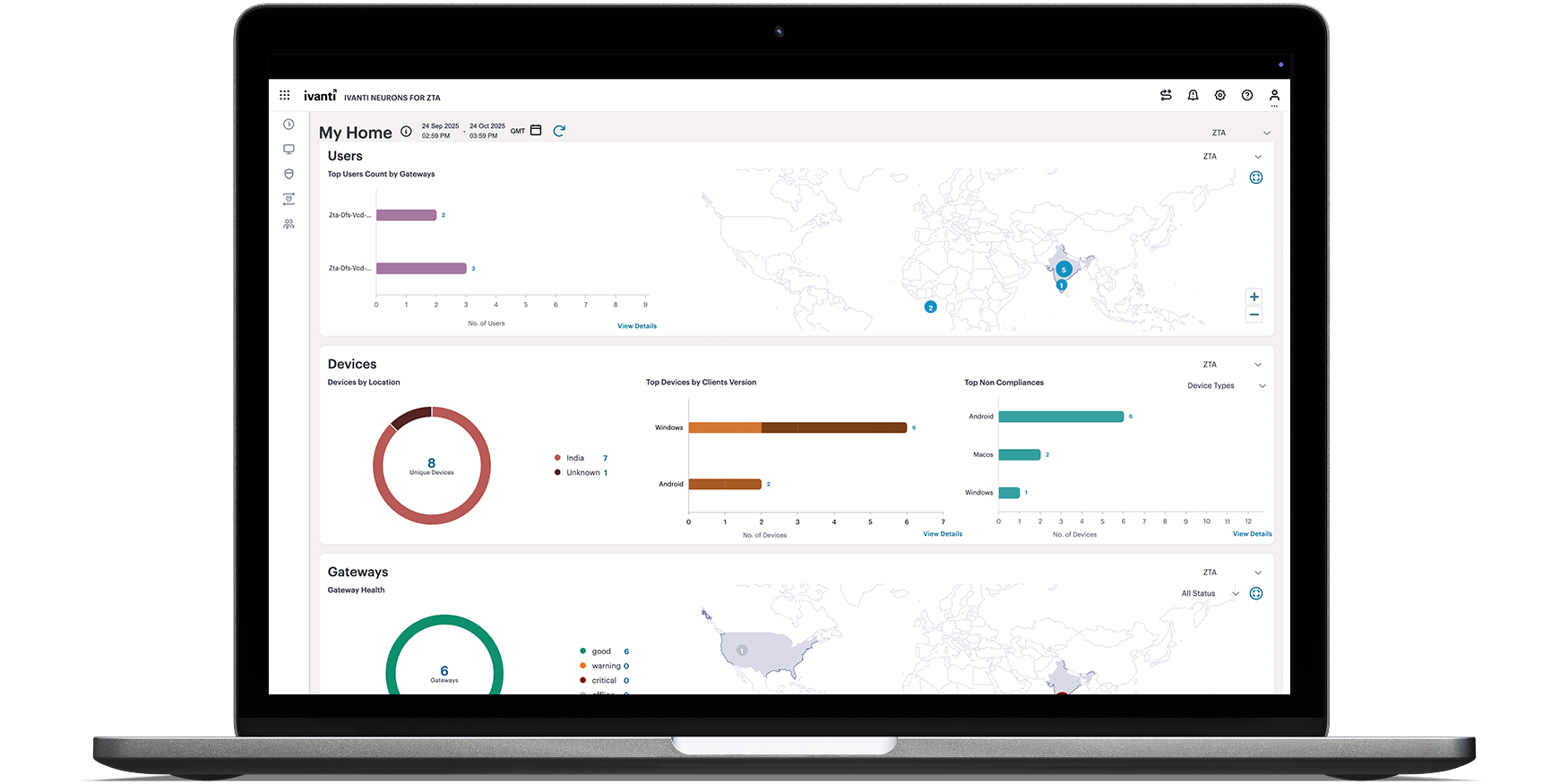
Secure application access with continuous zero trust verification

Ivanti ZTA combines application-focused access, continuous risk evaluation and behavioral analytics to reduce attack surface, prevent lateral movement and protect applications across on-premises, private cloud and public cloud environments.


Reduce attack surface with selective per-app access

Grant users access only to approved applications, not the network. Least-privilege controls minimize exposure and help prevent lateral movement. Automatically detect, classify and report user app usage. Automatically assess and prioritize user behavior and potential security concerns.

woman working outside

Enforce trust continuously

Continuously authenticate users, devices, applications and context before and throughout every session. Real-time risk assessment keeps access aligned with current trust levels. Streamline the process for securely onboarding employees, contractors and partners.

two people meeting

Detect threats proactively

Use UEBA, proprietary risk scoring and Vulnerability Risk Rating insights to prioritize risk, identify anomalies and vulnerable endpoint applications. Enforce access controls using real-time risk ratings and automatically quarantine unpatched devices running high-risk applications.

Man using a smartphone at a desk with an open laptop in a modern office

Optimize application access

Use intelligent traffic steering to select the optimal gateway and direct secure, per-application mTLS tunnels to avoid unnecessary backhauling. Provide secure access to private applications regardless of location. Prioritize user experience with secure, context-aware access to business-critical applications.

Person typing on a laptop beside a tablet, with computer code overlaid across the scene

Features and capabilities

Zero trust network access features for flexible, secure application access

Centralized policy engine

Govern every access request and session through centrally managed policy enforcement.

Adaptable application policies

Control access using user identity, device, location and other contextual attributes.

Flexible gateway deployment

Deploy gateways on-premises or in public and private cloud environments.

Cloud-hosted authorization

Authenticate identity and validate device security posture before establishing an application session.

Direct secure application tunnels

Create per-application mTLS tunnels between the Ivanti Unified Client and the ZTA gateway.

Endpoint compliance

Authenticate users and devices against granular policies before granting access.

Application discovery

Gain visibility into application usage and create ZTA policies without disrupting users.

Adaptive SSO authentication

Integrate through SAML 2.0 to provide SSO to supported SaaS and third-party applications.

Single-pane-of-glass visibility

See users, devices, applications, context and infrastructure with centralized compliance reporting.

Data privacy and sovereignty

Keep application traffic through customer-deployed gateways and separate from the ZTA control plane.

Invisible gateways

Keep application gateways unresponsive to unauthorized users while enabling approved access.

VPN integration

Work with existing VPN solutions to secure new applications and support phased zero trust adoption.

FAQs

What is zero trust network access (ZTNA) software?

Zero trust network access (ZTNA) software, such as Ivanti Zero Trust Access (ZTA), provides secure access by connecting authenticated users only to authorized applications based on identity, device posture and context. Unlike traditional network-centric approaches, ZTNA applies least-privilege access controls and continuously verifies trust throughout the session, helping reduce attack surface and prevent unauthorized access. 

How does Ivanti Zero Trust Access work?

Ivanti Zero Trust Access (ZTA) connects users directly to approved applications instead of the network. The solution continuously evaluates identity, device health, location, behavior, and other contextual signals to determine appropriate access, then enforces granular policies that adapt as risk changes. This enables organizations to secure application access while maintaining visibility and control across distributed environments. 

How does ZTNA differ from a traditional VPN?

Traditional VPNs provide secure connectivity to a network through an encrypted tunnel. ZTNA instead grants access only to authorized applications through application tunnels based on identity, device posture, and context. This least-privilege approach helps reduce attack surface, limit lateral movement, and provide more granular control over application access. 

How does Ivanti Zero Trust Access continuously verify users and devices?

Ivanti Zero Trust Access (ZTA) supports CARTA (Continuous Adaptive Risk and Trust Assessment) and authenticates users, devices, applications, and contextual factors before and during access sessions. Real-time risk assessment, device compliance checks, user and entity behavior analytics (UEBA), proprietary risk scoring and adaptive policy controls help ensure access remains aligned with current trust levels and can be adjusted automatically as risk changes. 

Can Ivanti Zero Trust Access secure applications across on-premises, private cloud and public cloud environments?

Yes. Ivanti Zero Trust Access is designed to secure application access across hybrid environments, including on-premises data centers, private clouds, and public clouds. Organizations can apply consistent zero trust policies across distributed applications while providing secure access for employees, contractors, and partners regardless of location. 

How does Ivanti Zero Trust Access detect and restrict risky devices?

Ivanti Zero Trust Access evaluates device posture, compliance status, user behavior and contextual risk signals before granting access. The solution uses Continuous Adaptive Risk and Trust Assessment (CARTA), UEBA, vulnerability-based risk insights and adaptive policies to identify anomalous, vulnerable or non-compliant devices. Based on risk level, organizations can automatically restrict access, require additional authentication or block access altogether.   

Ready to modernize application access?

Protect users, applications and data with continuous verification, adaptive controls and per-app zero trust access across every environment.