Scaling AI in IT Operations:The Path to Maturity in 2026
2026 AI Maturity Report
AI is delivering big wins for IT. Now comes the harder work: scaling what works, closing the governance gap and making sure the benefits reach every corner of the organization.
Early AI gains are real and measurable, but they only compound if an organization builds the foundation beneath them to scale.
In a signal of just how quickly AI has taken hold in IT, more than half (56%) of organizations are now deploying AI broadly across multiple workflows or at business-critical scale where AI is fully integrated and driving continuous improvements. Only 2% report no AI use at all.
The impacts from broad-scale AI adoption are showing up in the data: Nearly half (45%) of all IT workers say AI makes work faster and better, and 63% say they spend less time on repetitive tasks. But gains are not universal. How much benefit an organization sees depends heavily on how deliberately it has invested in governance, skills and the right use cases.
Within the IT environment, AI is embedded across IT service management (ITSM) and endpoint management — with more than half of organizations reporting broad or deeply embedded use in both areas.
In ITSM, the most common current applications include virtual agent and chatbot support (58%), ticket classification and routing (56%) and automated ticket resolution (51%).
In endpoint management, AI is already handling anomaly detection (57%), device vulnerability identification (55%) and patch prioritization (47%) — with even greater automation expected within 24 months.
Mature organizations aren't just using AI to flag endpoint issues — they're using it to resolve problems autonomously, closing the gap between detection and remediation without any human intervention. These capabilities form the foundation of autonomous endpoint management (AEM), where AI doesn't just detect issues but automatically resolves them.
On the predictive side, adoption of AI is nearly universal. Only 6% of IT organizations say they don't use AI for predictive purposes at all. Top applications include predictive maintenance, capacity planning (both 58%) and cloud cost management (53%).
In addition, 57% of IT organizations are using agentic AI for at least several important IT workflows, including 17% who rely on it for extensive end-to-end workflows. Another 32% are currently piloting agentic AI.
Deployment of AI agents is concentrated in Level 1 (L1) IT support (61%), network/infrastructure ops (59%), Level 2 (L2) specialist support and endpoint operations (both 57%). This makes sense since these are the functions where autonomous endpoint management (AEM) delivers its highest immediate value, and where organizations that invest in it stand to capture the most significant productivity gains.
Together, L1/L2 support, network/infrastructure and endpoint operations are the highest volume and most-repetitive functions in IT — precisely where agentic AI delivers the greatest return.
The disruptive pace of change that has characterized the last two years won’t slow anytime soon given that IT organizations expect AI to automate nearly half (46%) of their operations within 18 months.
Unsurprisingly, the makeup of the IT workforce is expected to change in parallel. IT pros anticipate a meaningfully higher share of AI agents on their teams in the next three to five years than office workers do — a gap that likely reflects both greater familiarity with AI's use cases in the enterprise as well as more mature adoption within IT-Ops. In that sense, IT professionals’ experience with AI at work is a bellwether for how the technology will reshape the broader workforce.
6 hours per week
The average time saved by IT workers with advanced AI experience.
The AI maturity edge
When an organization is mature in their AI use, they not only use the technology more often and more broadly than their peers; they also maintain clearer accountability for AI decisions and more formal governance structures. By doing so, organizations with fully-scaled, mature AI use achieve fundamentally different outcomes than peer organizations. Across productivity, collaboration and workforce planning, the gap between early experimenters and scaled organizations is dramatic.
Operational outcomes:
At organizations where AI is scaled/business-critical, 54% of IT pros say AI makes their work both faster and better — more than double the rate at organizations that rated themselves at early AI experimentation/pilot projects. (24%).
And IT pros who use AI at the most advanced individual level save an average of 6 hours per week — double the 3 hours saved at the least mature level of AI use.
The same performance gap is visible in proactive detection. At early experimentation organizations, 43% of IT pros say AI frequently helps their team detect issues before end users are aware. At scaled/business-critical organizations, that figure climbs to 89%. This finding represents one of the starkest divides in this research: Mature AI organizations don't just do more things; they operate at a categorically different level of IT performance and resilience.
AI maturity pays off
Mature AI organizations use proactive issue detection at double the rate of early experimenters and consistently outperform early-stage peers on resolution speed, customer satisfaction and cost savings.
Among scaled/business-critical organizations, 64% measure AI's impact through time to resolution, 64% through customer satisfaction scores and 65% through cost savings — compared to just 38%, 26% and 37% respectively at early experimentation organizations.
Organizational structure:
AI is also changing how IT organizations are structured and staffed. Across all companies, nearly three in four (72%) IT organizations have already created dedicated AI roles or teams, and another 13% plan to do so. For scaled/business-critical organizations, 91% report having dedicated AI roles/teams.
The most common AI-centric roles? AI product/program owners (54%), embedded AI specialists (51%) and governance committees (50%) are all becoming standard.
Broader organizational redesign is also underway: 37% of organizations report that at least a few roles or teams have been significantly reshaped because AI is now performing part of their work — a figure that climbs to 57% in the tech industry.
Workforce confidence/direction:
Mature AI environments also produce more adaptable and future-looking workforces. At the individual level, intent to upskill — the share of employees planning to update their skills in reaction to AI's impact — climbs sharply with individual AI maturity, from just 37% at the basic level to 86% among the most advanced users.
Exposure drives optimism:
Intent to upskill climbs from 37% among basic AI users to 86% among the most advanced — a 49-point gap that signals a workforce actively investing in its own future.
What AI is actually doing for IT
AI is saving IT teams thousands of hours, shifting operations from reactive to proactive, and unlocking capacity for the work that actually matters.
IT pros are redirecting recovered capacity toward work that previously went unaddressed.
Half (50%) of IT pros say AI helps them focus on more complex or strategic work, and 45% say it gives them better visibility and insights for decision-making. In other words, recovered hours are flowing toward the work that actually requires human judgment.
The real dividing line with AI maturity is the shift from reactive to proactive. AI is essential to that shift — but it can't do it alone. AI surfaces signals and guides decision-making; autonomous endpoint management provides the discipline and workflow structure that transforms those signals into action, empowering IT teams to resolve issues before end users ever encounter them.
At scale, AI-driven automation moves beyond just alerting; it's acting autonomously. For example: automatically adjusting performance settings (52%), isolating risky devices (50%), restarting services (47%) and applying patches (46%). For mature/scaled organizations, autonomous applications like these are used at more than double the rate of less mature organizations.
This is the operational core of autonomous endpoint management (AEM): not just smarter alerts, but AI that acts on signals without waiting for human intervention. Unlike traditional endpoint management, which relies on scheduled scans and manual remediation, Autonomous Endpoint Management bridges detection and resolution, often acting before end users know there was a problem at all.
The strategic unlock
Beyond hours saved, individual AI maturity also produces a fundamental shift in how IT professionals spend their workdays.
Nearly two in three (61%) advanced users of AI say it helps them focus on complex/strategic work, compared to 22% of basic users — a 39-point gap.
And more than half (54%) of advanced organizations say AI has improved cross-team collaboration, compared to 16% of basic-level organizations — a 38-point gap.
These points gaps represent among the larger maturity differentials in the research.
Plus, AI is breaking down silos that have historically slowed teams down. Sixty percent report using more common tools and platforms across IT, security and business teams; 57% say AI has improved knowledge sharing; 53% report sharing data more easily; and 50% have created joint workflows that span multiple teams. All of these figures climb significantly among IT pros who use AI more extensively.
IT leaders must now think carefully about how they will redeploy recovered time/capacity. The most forward-looking IT leaders are asking, "What should IT be doing that it never had time for?"
The organizations that will pull ahead are those that focus on business outcomes and ensure accountability is structural — embedded and clearly defined. Every IT leader must ask, ‘Is what we’ve adopted truly yielding the returns we want? Are employees seeing that same value?’ Because AI, at the end of the day, is making it possible for humans to be even better at what they do.
Sterling Parker
Senior Vice President of Global Solutions and Services, Ivanti
The governance gap
Organizations are moving faster on AI deployment than on AI governance. With nearly half of IT operations expected to be automated within 18 months, that gap is becoming a liability.
Governance is a nonnegotiable foundation for AI adoption, not simply a byproduct of increasing AI maturity. Building this foundation requires clear and embedded protocols (e.g., when AI can act autonomously and when it must escalate) as well as the organizational discipline to follow them.
Ivanti’s research shows AI deployment is accelerating rapidly, but the governance structures designed to support it haven't kept pace.
Most IT organizations report having basic AI governance processes in place:
65% say they have AI risk review processes.
59% say they have policies for evaluating/approving new AI solutions.
58% say they have acceptable AI use policies.
49% say they have AI oversight bodies.
But IT pros admit these protocols are not always followed.
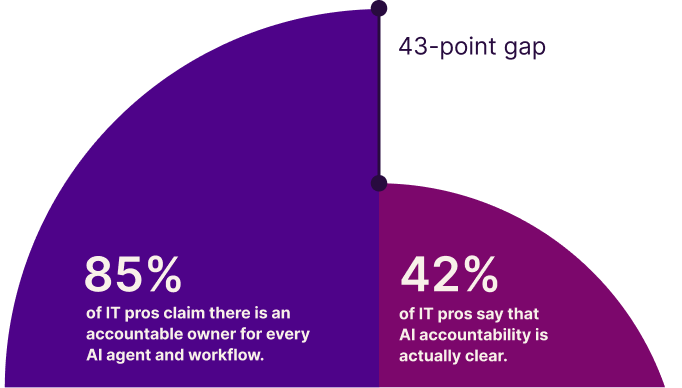
The accountability gap is stark: 85% of IT pros claim there is a named, accountable owner for every AI agent and workflow within their IT organizations. Only 42% say that accountability is actually clear.
Among companies that have AI policies, just 24% of employees say AI policies are followed “very consistently” (i.e., almost all the time) in day-to-day work. When accountability is unclear and policies are inconsistently followed, AI operates from fragmented, unverified data rather than a trusted system of record. The consequences compound quickly.
Unsanctioned AI adds another layer of complexity. When employees use unsanctioned AI tools to work around slow approval processes, they bypass existing governance structures, creating blind spots that undermine organizational oversight. Regulated industries — including government, healthcare and education — have the highest rates of unsanctioned AI tool use, and the lowest rates of employer-provided tools.
Another pressure point: Organizational leaders are nearly twice as likely to keep their AI use secret compared to all other employees (42% vs. 23%). Among leaders hiding their AI use, 52% say they do so for a "secret advantage."
Organizations that haven't closed the gap between nominal and actual accountability are essentially deploying AI and automation on a foundation that is neither secure nor designed to scale.
The good news:
Ivanti’s research shows that governance improves dramatically with maturity.
At scaled/business-critical organizations 69% report comprehensive governance is in place — vs. just 15% at early experimentation organizations. But even 69% leaves room for improvement: Nearly a third of the most mature IT organizations are still operating without fully embedded governance.
Making governance work at AI speed
Governance itself is now the most commonly cited barrier to faster AI deployment. Among IT professionals, 27% identify governance, security or compliance concerns as their organization's biggest deployment obstacle — outpacing skills shortages (20%), technology limitations (17%) and data challenges (14%).
To break this barrier, organizations must define when and how to trust AI outputs (i.e., when workflows require a human in the loop). These decisions are highly consequential; among IT pros, 68% have personally seen AI produce hallucinations with potential operational impact. More than half (52%) say their team caught the errors before they caused issues (16% weren't so lucky).
And yet, even with clear evidence of AI’s imperfections, IT professionals say they trust AI’s decision-making capabilities. Among the most advanced users of AI, 49% say they fully trust AI-generated outputs that influence IT decisions.
Effective governance resolves this paradox by codifying trust thresholds for different operations. For example, letting AIs autonomously restart failed services or apply routine patches, while requiring human validation for system-wide configuration changes or emergency incident responses.
Done right, governance accelerates deployment rather than blocking it.
Rather than playing an endless game of whack-a-mole with rogue AI use, forward-thinking companies are shifting toward governed enablement. That means transitioning to guardrail-based governance: establishing clear operating boundaries that let teams deploy confidently without case-by-case approval.
Brooke Johnson
Chief Legal Counsel, Senior Vice President of Security and Human Resources, Ivanti
AI experience drives optimism
IT professionals who use AI most are also the most confident about their role in an AI-enabled future.
Ivanti’s research shows that explicit fear of job displacement is low. Fully 79% of IT pros and 77% of office workers say they're "not at all" or only "somewhat" worried about AI reducing or replacing their jobs. And when asked how they'd feel about an open position being filled by an AI agent, 72% of IT pros say they'd be relieved or cautiously optimistic (compared to 42% of office workers).
In fact, many IT pros say AI has transformed their work lives for the better:
53% say AI has given them more control over their time and priorities.
49% find their work more interesting or satisfying.
46% report a better work-life balance.
A large share of IT pros view AI as much more than a useful tool; they see it as a workplace collaborator. Among the most advanced AI users, 37% now describe AI systems as mostly or fully a virtual teammate — up from just 10% at the basic level. And more than half of IT pros (53%) say they'd be comfortable having their performance compared to that of an AI agent.
Effective collaboration, however, doesn't mean unconditional trust. Most IT pros are clear-eyed about where human judgment remains nonnegotiable. For example, 55% say they would never rely on AI without human review for high-severity incidents, and 52% say the same for communicating incidents to executives or stakeholders.
Technical and soft skills wanted
As routine tasks shift to AI, the skills that matter most are shifting too. Most (83%) IT pros agree that, as AI automates more routine tasks, emotional intelligence (EQ) will become more important for their profession.
When AI handles tasks like detection and remediation, IT professionals shift from firefighting to strategy. Increasingly, IT pros will need to understand what the business needs, make judgment calls about risk and priorities, and explain complex technical decisions to people who aren't technical.
AI literacy is a key skillset for IT professionals and office workers alike.
IT pros rate their own AI literacy as high or very high — nearly double the rate of office workers (62% vs. 27%). This makes sense: They're much more likely to use AI frequently or as a fully integrated part of their work (51% vs 33%).
The difference in AI literacy between IT pros and office workers is also a source of friction.
Office workers reported it takes an average of 3.2 tries to get a usable output from their primary AI tool at work. For office workers who haven't received formal training or purpose-built tools, each reworked AI interaction is likely to produce frustration and erode trust in AI’s productivity promise before it ever has a chance to deliver.
Both groups need to sharpen their skills. Literacy isn't just about using AI; it's about knowing when to trust it, when to override it and when to push back.
The path forward
Early AI gains are real and measurable, but they only compound if an organization builds the foundation beneath them to scale.
Start where you are:
The maturity data carries an important message for organizations that feel left behind: Organizations don't have to leap to the most sophisticated AI deployments to see meaningful results. The gains begin early and compound with investment.
For most, that means getting more from automation they already have. A large number of IT teams are sitting on untapped capacity in tools and workflows. Expanding what's already working is faster, lower-risk and often more impactful than launching new AI pilots. But these early gains only compound if an organization is building on a foundation that can scale.
Build governance in, not on:
Organizations that have closed the governance gap share a common approach: Accountability is structural (i.e., embedded and automated in policy and practice). Every AI agent and workflow has a named owner, and escalation paths are defined before they're needed. Policies exist — and are actually followed. And governance is built in from the start, not bolted on afterward. Without this type of unified foundation, the risk of autonomous AI outweighs the reward.
Achieving best-in-class governance means:
Building governance controls into the platform itself so trust thresholds, escalation paths and approval requirements are enforced automatically.
Aligning CIO and CISO incentives around shared outcome metrics — risk appetite, uptime, resolution rates, employee experience.
Moving from siloed point solutions to platforms designed for autonomous operation that can connect signals to actions across the IT and security environment.
The payoff: automated decisions, intelligent remediation, fewer disruptions and lower risk.
You can’t govern what you can’t see. Organizations scaling successfully today are consolidating on a unified platform that serves as a system of record — especially for agentic AI components. That’s the foundation that makes AI auditable, predictable and scalable.
Sterling Parker
Senior Vice President of Global Solutions and Services, Ivanti
Redesign roles, don't just augment them
The organizations getting the most from AI are fundamentally rethinking what their teams do. More than 1 in 3 (37%) organizations report that at least a few IT roles or teams have been significantly reshaped by AI — a figure that climbs to 57% in the tech industry. And 72% have already created dedicated AI roles or teams, with another 13% planning to do so.
When AI handles routine detection, triage and remediation, IT's value shifts to work that requires context, judgment and relationships. The transition requires:
Redefining performance metrics. Reward strategic impact and cross-functional collaboration, not ticket closure speed.
Redesigning career paths. Create advancement opportunities for IT professionals who excel at translating technical complexity into business value.
Rethinking hiring criteria. Evaluate candidates on business acumen and communication skills alongside technical expertise.
Make upskilling systematic
Intent to upskill climbs from 37% at the basic level to 86% among the most advanced users.
In other words, the people who use AI most are also the most motivated to keep growing.
Organizations need to build structured programs to support this rising tide of AI interest and upskilling intent:
AI literacy training: While 62% of IT pros rate their AI literacy as high or very high, that still leaves more than a third who need foundational training. For office workers, the gap is starker: only 27% rate their literacy as high or very high, signaling a critical need for organization-wide AI education programs.
Business acumen training: Help IT professionals understand how their work connects to revenue, customer experience and competitive positioning.
Communication and influence skills: Develop soft skills, such as explaining technical decisions to nontechnical stakeholders and building buy-in for change among stakeholders.
Strategic thinking development: Create opportunities for IT professionals to work on cross-functional projects that require judgment, not just execution.
Exposure to AI, combined with strong upskilling support, produces more confident teams. Organizations that offer training, role redesign and career development tied to AI maturity are more likely to retain employees who are confident about AI’s impact, as well as their own ability to participate in it.
Given that more than half of IT organizations are already deploying AI at broad or business-critical scale, and 46% of all IT workflows are expected to be automated within 18 months, the window for measured, thoughtful action is narrowing. The question is no longer whether AI will transform IT — it’s already doing so. Rather, leaders must decide whether their organizations will shape the future of AI transformation, or be pulled along in its current.
Methodology
Ivanti surveyed 3,900 employees across six countries — the United States, the United Kingdom, France, Germany, Australia and Japan — in February and March 2026. Our goal: to understand how AI is reshaping IT operations and workforce dynamics across regions and industries.
The survey included two distinct respondent groups: 1,500 IT professionals whose primary responsibilities are related to IT or cybersecurity, and 2,400 office workers employed in non-IT roles. All participants worked for organizations employing a minimum of 500 people.
This report draws on two distinct maturity scales, each measuring a different dimension of AI adoption. The first is an organizational AI maturity scale, which reflects how broadly and deeply an organization has integrated AI into its IT operations. Respondents (IT professionals) rated their organization on a five-point scale ranging from "Early experimentation: pilots or proofs of concept" to "Scaled, business-critical use with continuous improvement." Throughout this report, comparisons focus primarily on organizations in the early AI experimentation stage and organizations with scaled/critical AI use — the two ends of the active adoption spectrum. Organizations reporting no AI use are excluded from maturity comparisons.
The second is an individual AI maturity scale, which reflects how deeply a person integrates AI into their own daily work. Respondents (IT professionals and office workers) selected from five profiles ranging from "Basic use: using AI chat tools occasionally for simple tasks" to "Advanced automation: creating AI-driven workflows or using AI agents that operate independently." Where findings are segmented by individual maturity, the report compares Basic users and Advanced automation users.
Collecting information through self-reporting has limitations, as people may be biased when evaluating their own efforts or their organization's capabilities. We ask that readers keep these limitations in mind when interpreting the findings.
This study was administered by Ravn Research, and panelists were recruited by MSI Advanced Customer Insights. Survey results are unweighted. Demographic and firmographic breakdowns are provided in the appendix; further detail by country is available upon request.