Complete Visibility and Network Access Control
Modern networks experience a proliferation of connected endpoints; BYOD connectivity is now surpassed by IoT. Every additional endpoint increases the risk to be compromised and gives attackers an opportunity to gain further access into the network and corporate resources. To limit this risk, an endpoint’s security posture must always show current software security updates and virus definitions, for example . Also, users must only be given the least amount of access necessary to perform their role.
Highlights
- Centralized visibility and policy management of all endpoints, including IoT.
- Granular assessment of endpoint security posture before allowing access.
- Dynamic network segmentation based on user role and/or device class.
- Granular integration with Ivanti vADC for a scalable, resilient and responsive solution.
- BYOD onboarding integration with Ivanti Neurons for Workspace or third-party EMM.
- REST API integration with network and security infrastructure devices, including switches, wireless LAN controllers and firewalls.
- Scales for organizations of any size.
Ivanti Policy Secure (IPS) and Profiler provides complete visibility and Network Access Control (NAC) for all endpoints. Its open, high-performance design helps small and large organizations easily enforce endpoint security compliance and zero trust security. The intuitive UI simplifies administration and provides customizable reporting.
Policy Secure continuously enforces foundational security policies and controls network access for managed and unmanaged endpoints, including IoT. Policy Secure uses zero trust principles to manage network access by validating the user and a device’s security posture and then connects the device with a least privilege access policy.
The open platform integrates with a wide range of switching, Wi-Fi and NGFW solutions to enforce access policies. Bi-directional integration with third-party security solutions improves overall security efficacy with automated endpoint access enforcement.
Automated responses to Indicators of Compromise (IoC) reduce remediation time and streamline administrative resources. Policy Secure integrates with a wide range of NGFWs including Palo Alto Networks, Checkpoint, Juniper and Fortinet, as well as SIEM solutions like Qradar and Splunk. Integration with McAfee ePolicy Orchestrator (McAfee ePO) fortifies endpoint management and automated threat response. For granular OT/IoT visibility and control, Policy Secure integrates with Nozomi Guardian.
Benefits
- End-to-end zero trust network access security.
- Reduced threat response time.
- Reduced risk from lateral spread of threats.
- Automated policy enforcement, reduced auditing burden.
- Simple and fast deployment.
Key Components
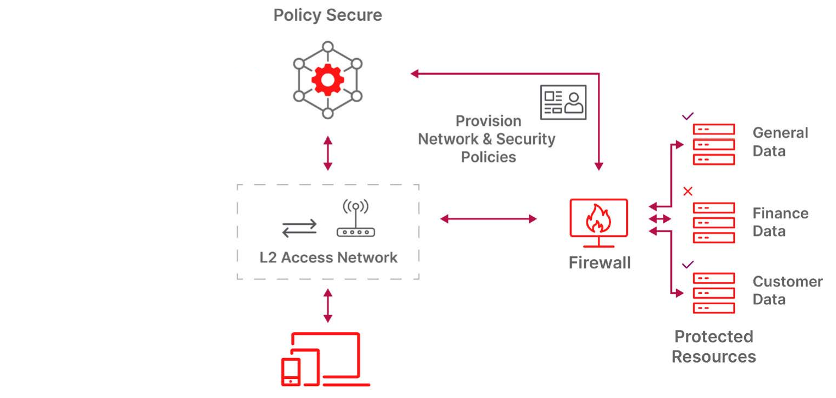
The Policy Secure and Profiler solution includes three components:
- Profiler identifies and classifies endpoint devices, including IoT. It provides end-to-end visibility, reporting and behavior analytics.
- Policy Secure provides a high-performance policy engine that leverages contextual information from users, endpoints and applications. With a unified, open framework and policy engine, administrators can apply granular rules for dynamic monitoring, reporting and access control of all endpoints, anywhere on the network, to minimize access risks.
- Client offers agent and agentless options for pre- and post-admission control. The solution incorporates the host checker functionality, which verifies an endpoint’s security posture. This is the same Client used for the Ivanti Connect Secure VPN solution and runs on Windows, Mac, Linux, Android and iOS platforms.
Use Case Overview
|
Challenges |
Policy Secure and Profiler Solution |
|---|---|
|
Profiling |
Profiler dynamically identifies and enables automatic and custom classification of both managed and unmanaged endpoint devices. This provides operational visibility, reporting and policy-based controlled access to networks and resources based on the user, device, applications and other attributes. |
|
Numerous device types |
Profiler can automatically classify devices against a growing database of more than 2.3M unique fingerprints. The solution profiles endpoints’ static or dynamic IP addresses and actively scans open ports to detect MAC spoofing. |
Visibility
To protect your network endpoints, you need to see what endpoints are connected. Complete visibility means having the insights to identify and classify all managed and unmanaged endpoints.
|
Challenges |
Policy Secure and Profiler Solution |
|---|---|
|
Discovery, profiling and segmentation of IoT devices |
Profiler discovers managed and unmanaged IoT devices. It profiles them so they can be matched to specific access policies. Dynamic segmentation limits the risk of threats spreading laterally and helps with regulatory compliance. |
The Internet of Things (IoT)
Enterprises today merge IoT devices with the IT environment to improve business efficiencies. Policy Secure offers enterprises the ability to discover and secure these devices.
|
Standard |
Certification Details |
|---|---|
|
NIST / FIPS |
Certified by using openSSL.org FIPS provider/module in IPS 22.7R1 release or later. |
|
NIAP |
Certified as Compliant Product, IPS 22.2 or later. |
Device Onboarding and Policy Compliance
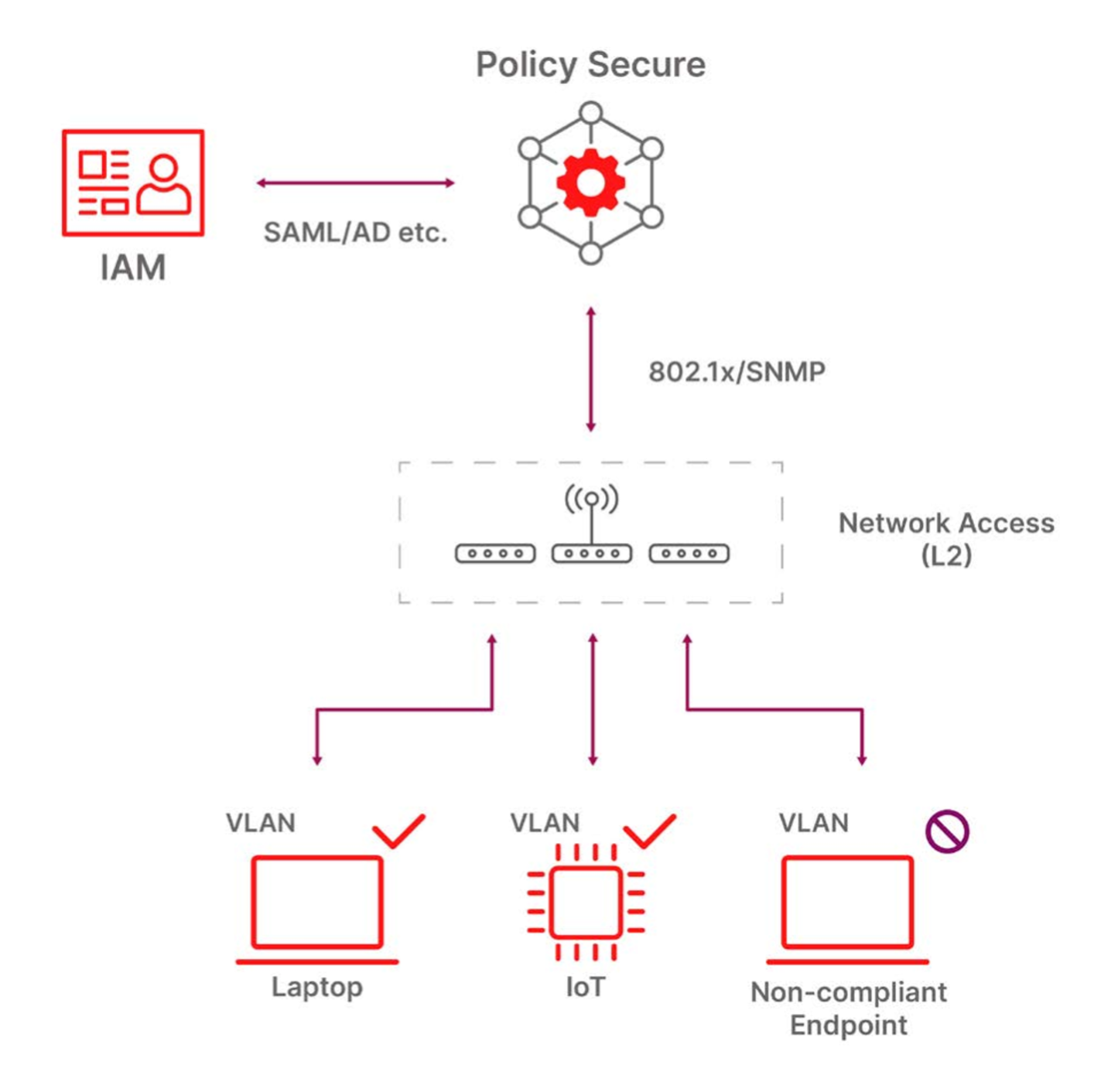
Policy Secure prevents unauthorized network, application or data access by dynamically assessing and remediating device security before the device connects to the enterprise. This protects the corporate network from infected devices and enforces consistent, cross-network access policies. It also ensures only authorized workers have access to enterprise resources based on their role, location and time of day.
Security Standards and Certifications
Ivanti Policy Secure and Profiler adheres to National Institute of Standards and Technology (NIST) Federal Information Processing Standards (FIPS) and National Information Assurance Partnership (NIAP) standards to help ensure the security and interoperability of systems and products, and to protect the confidentiality, integrity and availability of data.
|
Challenges / Key Features |
Policy Secure and Profiler Solution |
|---|---|
|
Guest user support |
Policy Secure and Profiler provides a self-service portal with a customizable interface. It is a highly scalable enterprise guest access platform that supports thousands of guest users. For additional control, secure guest access can be enabled by an admin, such as a receptionist, or by a sponsor who approves the guest’s access request. Policy Secure integrates with wireless controllers like Aruba, Cisco, Huawei, Juniper Mist, Meraki and Ruckus. |
|
BYOD onboarding |
Empowers employees to use their personal devices for work with self-service onboarding of personal laptops and mobile devices. |
|
Profiler |
Identifies and classifies endpoint devices, including IoT. It provides end-to-end visibility, reporting and behavior analytics. |
|
RADIUS/802.1X support |
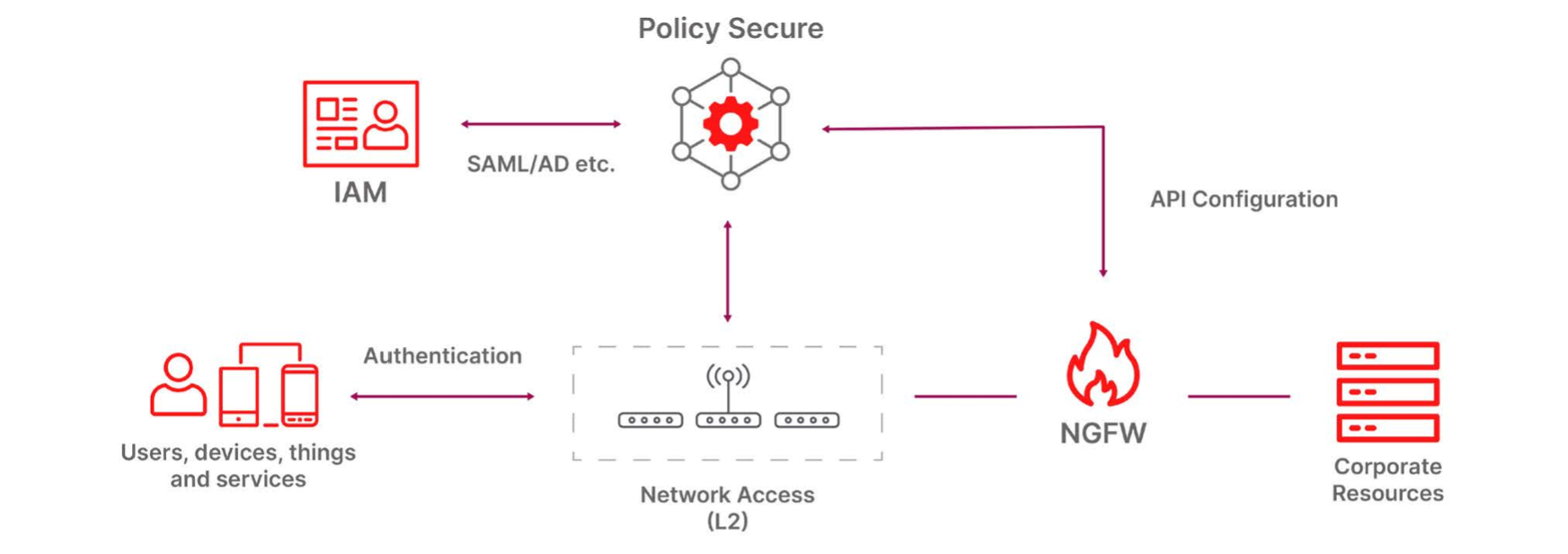
An integrated, high-performance RADIUS authenticates users and devices that are forwarded from industry-standard 802.1X functions on network switches and wireless controllers. |
|
TACACS+ support |
Use the TACACS+ authentication system to distribute policies to the access infrastructure. Supports two-factor authentication with smart cards. |
|
Host checker |
Identifies the security posture of the device. Options include OS or software patch status and active apps. |
|
Identity-based admission control |
Shares identity context with NGFWs from vendors such as Fortinet, Palo Alto Networks, Checkpoint and Juniper SRX, enabling each to be employed as policy enforcement points on the network perimeter. |
|
Automated threat response |
Leverages external threat intelligence alerts from NGFW or SIEM solutions to take automated actions at the device connection level. Policy engine leverages rich contextual information to allow various mitigating actions based on threat severity. |
|
Captive portal |
Provides user-friendly access control for guests and contractors. |
Additional Key Features
|
Key Feature |
Description |
|---|---|
|
Self-service guest access support |
Provides secure, simple and differentiated guest access. |
|
Wizard-based configuration |
Simplifies configuration tasks for administrators to avoid mistakes and faster deployment. |
|
Granular auditing and logging |
Granular logging capabilities of system, user and device events in a clear, easy-to-understand format. Can be analyzed locally or shared with external syslog solutions or SIEMs such as Qradar and Splunk. Supports WELF format and WELF-SRC-2.0-Access Report. |
|
Centralized policy management |
Saves administrative time and cost and delivers a superior user experience with common remote and local access control policy implementation and enforcement across a distributed enterprise. |
|
REST API |
Standardized interface for third-party systems such as NGFWs and SIEMs to integrate with Policy Secure and Profiler and limit an endpoint’s access on the local network. |
|
Flexible deployment options |
Policy Secure and Profiler runs on physical, virtual and cloud platforms. See the Supported Platforms Guide for details. |