Key Takeaways
- Generative AI creates new data exposure points at every stage of the workflow, from prompt input to interaction logging, making data visibility a non-negotiable security requirement.
- The most common generative AI risks include sensitive data leakage, prompt injection, unauthorised data retrieval and weak logging controls, all of which can be reduced by classifying data before it enters any AI system.
- Secure AI adoption comes down to five actions: classify sensitive data, restrict access to AI-connected knowledge sources, define approved AI use, monitor activity and govern how AI records are stored and deleted.
Your employees aren't trying to create compliance incidents by using AI tools. They're trying to finish their work faster. According to a 2026 BCG survey, 74% of frontline employees now use generative AI every day or a few times a week. When an employee uses an enterprise AI assistant to summarise a customer contract before a meeting, another pastes application logs into a public generative AI tool to troubleshoot an issue, or a developer relies on an AI coding assistant connected to an internal knowledge base, each action moves organisational data into a new processing pipeline that traditional security and privacy programmes were not designed to govern.
Unlike traditional applications, generative AI processes retrieve enterprise data, maintain context, create new content and may log interactions for improvement or audit purposes. Each of these stages introduces a potential exposure point and broadens your organization’s attack surface.
For data privacy and compliance teams, the use of generative AI in the workplace raises new questions they may not be able to easily answer during your next inquiry or audit such as: who authorised that AI tool to process this data, where did it go and how long was it retained? For CISOs and privacy officers, that gap between what employees do and what governance programmes currently cover is where generative AI security risks arise. The issue is no longer whether to adopt AI, but whether organisations understand where their data goes once AI enters the workflow.
What are the security risks of generative AI?
Generative AI is more than another enterprise application. It changes how organisational data is accessed, interpreted, shared and retained. Generative AI systems interact with prompts, internal repositories, conversational context and generated outputs, creating new exposure points if those interactions are not properly governed.
Key security risks include:
- Sensitive data leakage: Employees may unintentionally share confidential information, source code, customer records, or intellectual property with shadow AI tools that are not approved to process that data.
- Prompt injection attacks: Malicious prompts or hidden instructions can manipulate AI behaviour, bypass safeguards, retrieve unauthorised information, or generate misleading responses.
- Unauthorised data retrieval: If knowledge sources have broad or misconfigured permissions, AI applications may expose documents users should not be able to access.
- Context and conversation leakage: Without session isolation and memory controls, sensitive information shared in one interaction may resurface later in the same conversation or influence future responses.
- Weak logging and retention controls: Prompts and outputs can contain sensitive business or personal data. Without defined retention, masking and access controls, logs can become new repositories of regulated information.
These risks may look technical, but they are primarily governance challenges. Generative AI amplifies existing gaps in data classification, identity and access management, monitoring and information governance. Organisations that know where sensitive data resides, who can access it, and how it should be protected are better positioned to adopt AI securely.
How generative AI affects data privacy
Generative AI changes how organisations collect, process, store and share data. Unlike traditional applications with defined processing paths, generative AI systems interpret prompts, retrieve information from multiple sources, generate new content, and may retain interactions for monitoring, auditing, or service improvement. This expands how sensitive data moves through the enterprise.
Key privacy challenges include:
- Greater exposure of personal and confidential data: Employees may include personal data, customer records, financial data, or intellectual property in prompts, potentially moving that data outside direct organisational control.
- Expanded processing scope: AI applications often combine prompts with data from internal repositories and business systems, raising questions around purpose limitation, data minimization and access governance.
- New retention obligations: Prompts, outputs and system logs may contain regulated or confidential data, requiring clear rules for retention, access and secure deletion.
- Higher risk of unauthorised disclosure: Weak access controls, prompt injection, or overly broad retrieval mechanisms can expose information users were never intended to process.
Generative AI does not change the core principles of data privacy; it makes them harder to apply consistently. Data minimization, purpose limitation, transparency, security of processing and accountability must now extend across the full AI data lifecycle.
The five data-flow risks security risks introduced by gen AI
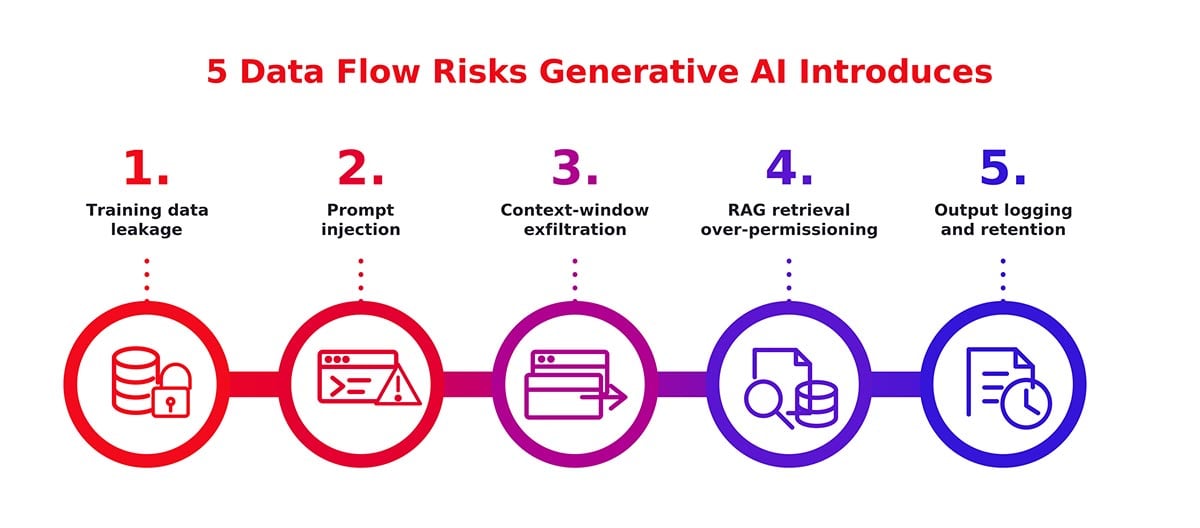
1. Training data leakage
When employees use public AI tools with confidential pricing, customer records, source code, or internal documents, sensitive data can leave the organisation’s governed environment. Even if the provider does not use the data for training, the organisation may lose visibility into how that information is processed, retained, or shared. The leadership question is simple: should this data have entered an AI system at all?
2. Prompt injection
Prompt injection allows malicious instructions hidden in prompts, documents, or web content to influence AI behaviour. For enterprises, the risk is that an AI assistant connected to internal knowledge sources may bypass intended safeguards, expose sensitive information, or generate misleading outputs. This requires AI-specific monitoring, testing and guardrails beyond traditional input validation.
3. Context-window exfiltration
AI systems retain conversational context to improve continuity, but that same memory can expose sensitive information beyond its intended use. For example, confidential HR, legal, or customer details shared for one task may resurface later in the same session. One must ensure session isolation, memory limits and clear controls for sensitive workflows.
4. RAG retrieval over-permissioning
Retrieval-Augmented Generation makes enterprise AI more useful by connecting models to internal knowledge sources. However, if permissions are broad or misconfigured, AI may surface documents users should not access — such as legal files, executive compensation data, or restricted HR records. Strong identity governance and repository audits are essential before scaling AI broadly.
5. Output logging and retention
AI prompts and responses may be stored in logs, monitoring systems, backups, or analytics platforms long after the original business purpose ends. If those records contain personal, customer, or regulated data, they become new governance obligations. Organisations should define retention, storage, access, masking and deletion rules for AI-generated content.
How organisations can ensure data privacy when using generative AI
Protecting privacy in generative AI is not about slowing innovation. It is about governing how data moves through prompts, retrieved knowledge, model outputs, conversational context, and AI-generated content.
Foundational practices include:
- Classify data before AI use: Identify personal data, financial records, intellectual property, and regulated data before they enter AI systems. Give employees clear guidance on what can and cannot be shared.
- Understand and manage cross-border data flows: Generative AI introduces additional cross-border data transfer risks that organisations must understand and assess before connecting data sources, knowledge repositories, or third-party AI services.
- Enforce least-privilege access: Ensure AI applications retrieve only the information a user is already authorised to access, especially when connected to for example RAG-based knowledge repositories.
- Govern prompts and outputs: Define policies for logging, monitoring, retention, storage, masking, access, and secure deletion of AI interactions.
- Build privacy into AI design: Incorporate privacy by design and default, data minimization, masking, and human oversight during AI design and deployment — not after implementation.
- Train employees on responsible AI use: Use awareness training and acceptable-use policies to reduce accidental exposure from well-intentioned AI usage.
Ultimately, technology alone cannot ensure AI privacy. Secure adoption requires governance across security, privacy, legal, compliance, and product teams. By understanding AI data flows and applying controls at every stage, organisations can use generative AI while protecting sensitive information, maintaining trust, and meeting regulatory obligations.
Regulatory overlay: GDPR, CCPA and the EU AI Act
Security incidents involving generative AI rarely remain just security incidents. Once personal data or confidential information is exposed, organisations must also consider their privacy and regulatory obligations. Rather than introducing entirely new compliance requirements, generative AI amplifies the need to apply existing privacy principles consistently across new AI-driven data flows.
The table below maps common gen AI risks to the obligations they are most likely to trigger.
|
Risk area |
Business impact |
Regulatory focus |
Leadership action |
|
Training data leakage |
Sensitive data leaves governed environments and may be reused or retained externally. |
Data minimization, lawful use, transparency, and vendor accountability. |
Approve AI usage policies, restrict public tools, and validate provider controls. |
|
Prompt injection |
Malicious instructions can bypass safeguards and expose sensitive information. |
Secure processing, access controls, risk management, and incident response. |
Fund AI threat monitoring, testing, and prompt-filtering controls. |
|
Context-window exfiltration |
Sensitive details may remain visible across a session beyond their intended purpose. |
Confidentiality, purpose limitation, data minimization, and privacy by design and default. |
Require session isolation, memory limits, and clear controls for sensitive workflows. |
|
RAG over-permissioning |
AI may surface documents users are not authorised to access. |
Least privilege, access governance, accountability, and human oversight. |
Mandate IAM alignment, repository audits, and regular permission reviews before scaling AI. |
|
Output logging and retention |
Prompts and outputs can become unmanaged stores of regulated data. |
Retention, deletion, auditability, records management, and data subject rights. |
Set retention standards, protect AI logs, and include outputs in deletion workflows. |
Across all five risks, the central issue is governance. Regulators expect organisations to understand how personal and sensitive data moves through AI systems, apply effective controls, and demonstrate accountability when those controls fail. The EU AI Act reinforces this expectation by emphasising transparency, risk management, human oversight, and accountability across the full AI lifecycle.
AI does not create entirely new privacy principles; it exposes and amplifies existing governance gaps. Rather than building a separate AI compliance programme, organisations should extend current privacy and security controls into AI workflows. A practical starting point is to ask:
- Have we defined what data and identified the data sources that employees are allowed to use with AI systems?
- Do AI applications retrieve only information users are authorised to access?
- Are prompts, responses, and AI logs covered by retention and protection policies?
- Can we explain and audit how data moves through our AI applications?
If the answer is yes, the organisation has a strong foundation for responsible AI adoption. If not, these are the governance gaps to close before scaling AI across the enterprise.
Govern AI where your data moves
Organisations do not need to slow down AI adoption to manage risk. They need to extend the controls they already trust — data classification, access governance, monitoring, retention, storage and cross-functional review — into the AI workflows where sensitive information now moves.
Start with five practical actions:
1. Classify sensitive data: Know which data should never enter public or unapproved AI tools.
2. Lock down AI-connected knowledge sources: Apply least-privilege access before connecting internal repositories to AI assistants.
3. Define approved AI use: Make it clear which tools employees can use and what types of data those tools may process.
4. Monitor AI activity: Watch prompts, outputs, and usage patterns for sensitive data exposure or unusual activity.
5. Govern AI records: Set retention, storage, deletion, masking, and access rules for prompts, responses, logs, and generated content.
These steps do not require a new compliance function or a separate AI governance bureaucracy. They require consistently applying the same security and privacy fundamentals organisations already use to AI systems, AI users and AI-generated data.
Trustworthy AI starts with practical governance. The operating principle is straightforward: Govern AI at the points where data enters, moves, and is stored. Generative AI changes how information flows across the enterprise, but it does not change what leaders must manage: visibility, access, accountability, and control.
Start by mapping your AI data flows today. Organisations that reap the greatest benefits from AI will be those that understand where their data goes, define acceptable use and embed governance into everyday AI workflows rather than after-the-fact reviews. The next step is to start with the data flows you can see today, close the obvious gaps, and expand controls as AI adoption grows.
FAQs
What are the main generative AI security risks for enterprises?
The primary generative AI security risks include sensitive data leakage, prompt injection attacks, unauthorised data retrieval through misconfigured systems, context-window exfiltration, and weak logging and retention controls Each stage of the AI data pipeline — from prompt input to content generation and interaction logging — introduces a potential exposure point.
How can employees accidentally expose sensitive data when using generative AI?
Employees may unintentionally share confidential information, source code, customer records, or intellectual property with AI tools that are not approved to process that data. When public AI tools are used with confidential pricing, internal documents, or customer records, that data can leave the organisation's governed environment.
What is a prompt injection attack and why is it a generative AI security risk?
A prompt injection attack uses malicious instructions hidden in prompts, documents, or web content to influence AI behaviour — potentially bypassing safeguards, exposing sensitive information, or generating misleading outputs. For enterprises with AI assistants connected to internal knowledge sources, this risk is especially serious because it can override intended access controls.