Use Case

Manage your IT asset lifecycles

Reduce costs, prove compliance and make confident asset decisions across every lifecycle stage.

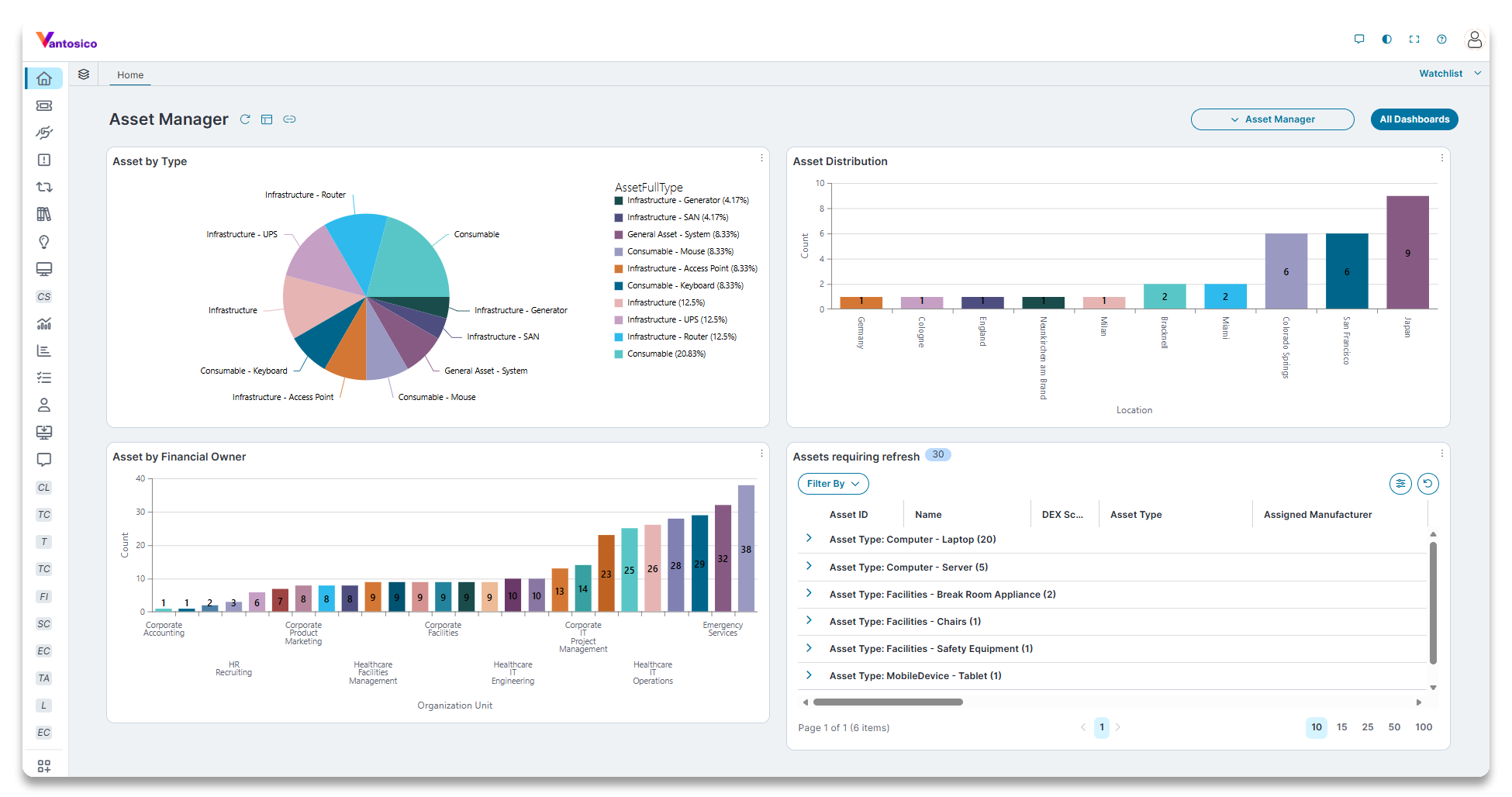
Asset management dashboard with a pie chart, two bar charts, and a table of assets requiring refresh

Turn asset lifecycle data into cost savings and compliance for audit readiness

When you know the status of every IT asset, you can reduce costs, protect your budget and manage vendor contracts and warranties with confidence. That visibility is built continuously into the Ivanti Neurons Platform, so every lifecycle decision starts with data you can trust and every action your teams take is grounded in reality.


Boost productivity

Always-current asset data allows you to provision faster, plan hardware refreshes before devices fail and eliminate the productivity drag of outdated or unavailable tools.

A woman holds a tablet and looks at the screen while tapping it

Reduce maintenance costs

Continuous asset intelligence surfaces devices and warranties that need attention. Your team can plan purchases and repairs before they become urgent cost problems.

Bearded man with a backpack holding an overhead rail on public transportation while looking at his smartphone

Maximize asset use

Know what's available, what's assigned and what's actually in use, so every IT investment delivers value and nothing sits idle.

Person typing on a laptop at a desk with notes, a pen, a coffee cup and glasses

Prove compliance and ace audits

Ivanti Neurons Platform continuously updated and validated asset data helps your team maintain current compliance records instead of rebuilding them before an audit. Pull accurate, defensible documentation on demand.

Close-up of a hand using the touchscreen on a multifunction printer

Manage contracts, warranties and vendor relationships

Connect vendor contracts, warranty expirations and reseller purchasing data directly to your asset records, so renewal decisions, procurement planning and vendor negotiations are always grounded in complete, current information.

Woman with braided hair looking at a smartphone

Features and capabilities

Everything you need to manage the full asset lifecycle management

Replace manual reconciliation and ghost assets with a trusted system of record for asset, endpoint and configuration state to deliver accurate, actionable intelligence in minutes.

Stay current with always-on, passive and active discovery

Passive and active discovery continuously finds all managed and unmanaged devices, including those behind a firewall, so your asset inventory stays accurate without manual effort.

Get complete device context, automatically

The moment a device is discovered, its full profile (hardware, installed software, current usage state and configuration) flows into your asset records automatically. No manual data gathering, just the context your team needs to make faster lifecycle decisions throughout the asset lifecycle.

Extend full asset visibility across environments

The Cloud Services Appliance gives you secure inventory access to remote devices connecting via the internet, extending full asset visibility to cloud and remote environments without the cost or complexity of a VPN.

Work from a single source for consistent asset categories

Normalize and reconcile asset data across every source, so your team works from a single, consistent taxonomy, without duplicate records, conflicting names, or confusion.

Enhance asset records with data from every source

Enrich asset records with data from multiple external sources, including hardware warranties, vendor licensing rules and purchasing history, so every lifecycle decision is backed by complete, contextual information.

Turn asset data into business-ready dashboards

Visualize asset data alongside information from across your business. Build business value reporting or explore trends, anomalies and live data in custom visual reports.

Manage software assets with accurate, continuously updated inventory

Understand exactly what software is installed across your environment, how licenses are assigned and what you're spending. With purchasing and vendor data built in, your team has the context to make smarter procurement decisions.

See the full picture of devices, apps and users

Map the connections between every device, application and user in your environment. When you can see dependencies clearly, change management gets safer and incident response gets faster.

FAQs

What is IT asset lifecycle management?

IT asset lifecycle management is the practice of tracking, governing and optimizing every IT asset from the moment it is acquired to the day it is retired. It covers the full chain of decisions an organization makes about its hardware and software estate: procurement, deployment, maintenance, compliance and disposal, ensuring that assets are always accounted for, properly assigned and delivering value. 

Effective IT asset lifecycle management depends on accurate, current data. Within the Ivanti Neurons Platform, continuous discovery and automated data reconciliation establish a system of record for asset, endpoint and configuration state across IT and Security, giving teams the trusted foundation they need to manage assets with confidence at every stage of the lifecycle. 

What are the stages of the IT asset lifecycle?

The IT asset lifecycle moves through five core stages: procurement, deployment, operations, maintenance and retirement. 

During procurement, assets are purchased and vendor contracts, warranties and licensing terms are established. At deployment, devices and software are provisioned and assigned to users or business functions. Operations is the longest stage, where assets are actively managed, monitored and tracked as usage and configuration change. Maintenance covers refresh planning, hardware upgrades and software updates that extend asset life and prevent failure. At retirement, assets are decommissioned and disposed of in a way that protects data and recovers residual value. 

Within the Ivanti Neurons Platform, each stage is supported by continuously updated asset data, so your team can provision faster, plan refreshes before devices fail, stay audit-ready throughout and make disposal decisions grounded in complete lifecycle context rather than incomplete records. 

How does IT asset lifecycle management software work?

IT asset lifecycle management software works by establishing and maintaining an accurate, continuously updated record of every asset in your environment, then making that data actionable across the lifecycle. 

Within the Ivanti Neurons Platform, the process starts with passive and active discovery that continuously finds every managed and unmanaged device, including those behind a firewall. The moment a device is discovered, its full profile, including hardware details, installed software, current usage state and configuration, flows into your asset records automatically. That data is then normalized and reconciled across every source, so your team works from a single, consistent taxonomy without duplicate records or conflicting information. Vendor contracts, warranty expirations and purchasing data are embedded directly into asset records, keeping procurement and renewal decisions grounded in complete, current context. 

The result is a system of record for asset, endpoint and configuration state across IT and Security, one that your team can act on at every stage of the lifecycle without manual reconciliation. 

Why is IT asset lifecycle management important for compliance?

Compliance failures in IT environments most often trace back to incomplete or outdated asset data, such as devices that weren't inventoried, configurations that drifted, or documentation that had to be assembled manually under pressure before an audit. 

IT asset lifecycle management addresses this at the source. Because asset data within the Ivanti Neurons Platform is continuously updated and validated, compliance reporting and audit readiness remain current throughout the lifecycle, not scrambled together before every audit. Your team can pull accurate, defensible documentation on demand, with vendor contracts, warranty records and purchasing history already embedded in asset records. 

The result is an organization that stays continuously audit-ready rather than periodically audit-prepared, reducing the time, cost and risk associated with compliance reporting at every lifecycle stage. 

How can Autonomous Endpoint Management improve IT asset lifecycle management?

Autonomous Endpoint Management is the outcome that trusted asset lifecycle data makes possible. When your asset records are continuously updated and accurate, guided AI and admin-controlled automation can use this trusted context to remediate issues, enforce configurations and manage endpoints at scale. 

In practice, Autonomous Endpoint Management improves IT asset lifecycle management by closing the gap between knowing the state of an asset and doing something about it. Continuous discovery within the Ivanti Neurons Platform keeps asset data aligned with the real-time state of your environment. Autonomous Endpoint Management uses that trusted foundation to detect issues, decide on the right action based on accurate context and execute approved actions, whether that means patching a vulnerable endpoint, reclaiming an idle device, or triggering a refresh workflow before a hardware failure disrupts operations. 

The lifecycle benefit is compounding: the more current your asset data, the more your automation can do autonomously and the less your team spends on manual validation, reactive firefighting and pre-audit reconciliation. 

Take control of every IT asset, from day one to “done”

See how the Ivanti Neurons Platform delivers always-current asset intelligence across your full IT estate.